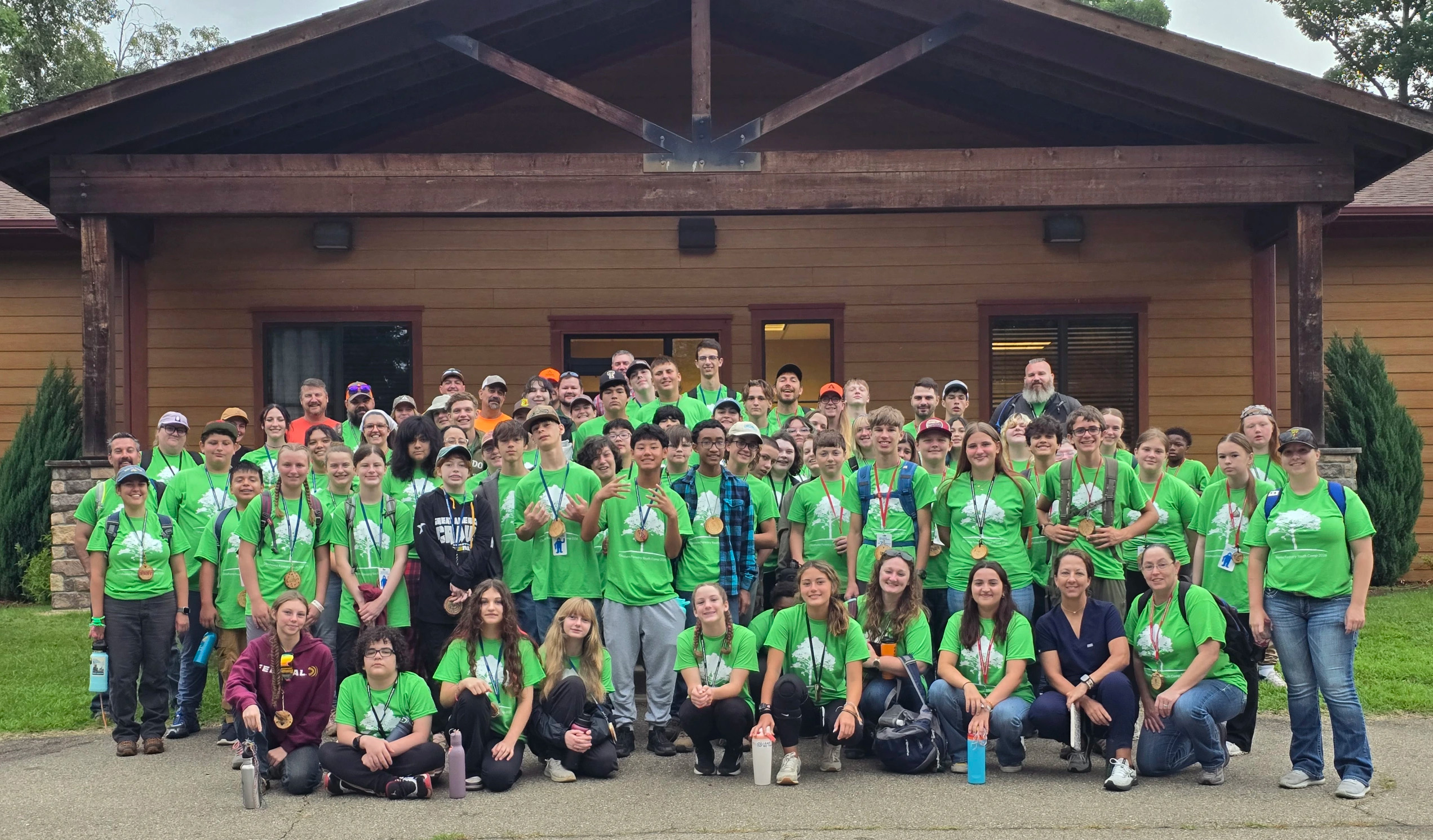
Oklahoma Youth Forestry Camp participants visit our Broken Bow, Oklahoma, Timberlands office.
Our Timberlands team in southeast Oklahoma and southwest Arkansas is making a big impact in the community, particularly in the lives of young aspiring foresters.
In 2025, our Broken Bow office, which employs about 10 people, disbursed more than $70,000 in Giving Fund grants to conservation services, fire departments, schools, forestry camps and contests for children and teens. The team also volunteers their time and expertise to educate local students about sustainable forestry and careers in the industry.
AElena Collinson, administrative assistant for our Broken Bow office, is one of many local volunteers who are passionate about introducing kids to forestry — in 2025 she logged more than 150 volunteer hours in our TREE-Mendous Matching Gifts Portal. Every summer she volunteers at the Oklahoma Youth Forestry Camp, an overnight camp for middle schoolers, and Camp Discover, a day camp for children aged 9 to 11. Both camps are held at Beavers Bend State Park in Broken Bow — thanks in large part to AElena and our Weyerhaeuser Giving Fund.
KEEPING FORESTRY CAMPS OPEN
The Oklahoma Youth Forestry Camp, now in its 68th year, is a one-week camp that provides nearly 60 students aged 13 to 15 with an immersive introduction to forestry, environmental stewardship and natural resource management. The camp offers a host of fun activities — swimming, canoeing, hiking, fishing, archery and tree climbing — in addition to educational programming from Project Learning Tree, an educational initiative of the Sustainable Forestry Initiative®.
However, just a few years ago, the camp’s future was in jeopardy. Critical repairs were needed to its facilities — especially the mess hall, which had deteriorated to the point that failing ceilings were creating a safety hazard.
Tony Pascall, camp director and education coordinator with the Oklahoma Department of Agriculture, Food and Forestry, warned the Oklahoma Forest Heritage Center board that without significant repairs, he would no longer be able to host the camp at Beavers Bend.
AElena, who sits on our Arkansas/Oklahoma Giving Fund committee and the board for the Oklahoma Forest Heritage Center, helped assemble a coalition that included leaders from Weyerhaeuser, the local timber industry and Oklahoma State University to understand what was needed.
The group concluded that repairs would cost around $62,000. The Oklahoma Forest Heritage Center, which coordinates the Oklahoma Youth Forestry Camp, received $15,000 for building renovations through a Giving Fund grant and an additional $35,000 from our Strategic Community Partnership Fund. Thanks to the boost provided by these grants and numerous smaller donations from local companies and community members, the camp was able to start repairs to ensure it could continue operating.
“We wouldn’t have been able to do what we did without that grant money,” AElena says. “It helped us tremendously.”
ABOVE AND BEYOND FINANCIAL SUPPORT
Along with providing funding for building repairs, AElena and her colleagues have supported the camp through educational opportunities. The camp’s Project Learning Tree programming includes activities such as making paper, learning about insects in the forest and measuring carbon in trees. This past June, campers went on a field trip to our Kiamichi timberlands, where employees from Broken Bow and De Queen, Arkansas, demonstrated some of the many ways to participate in forestry.
“Campers learned about planting and harvesting trees and the practice of sustainable forestry from silviculturists and foresters,” Tony says. “The kids showed a lot of interest and asked a ton of questions.”
Students from across the state submit applications to attend camp, and Tony reviews each one. He aims to include a wide diversity of campers from both cities and rural parts of the state.
“The camp culture is amazing,” he says. “Every kid is learning and happy to be there. It’s something I’m very proud of.”
PATHWAYS FOR HIGH SCHOOLERS, TOO
Oklahoma high schoolers are learning about forestry through Weyerhaeuser programming as well. In April, our Broken Bow office hosted the annual McCurtain County Forestry Contest. About 60 high school students participated in the one-day event that featured competitions such as tree identification, tool identification, compass and pacing, and volume estimation.
Kelly Kemp, silviculture manager in Broken Bow, has volunteered at forestry contests for the last five years and helped organize the Broken Bow event. He helps judge events and serves as the primary contact for the Oklahoma Department of Agriculture, Food and Forestry and the Natural Resources Conservation Service as they coordinate local competitions.
At the contest in April, Kelly talked to students about what the forester profession entails.
“I try to relate each competition to what we actually do as foresters and silviculturists at Weyerhaeuser,” Kelly says. “For example, I’ll explain why tree identification is important and what exactly the participants are doing when they’re measuring saw logs.”
INVESTING IN THE NEXT GENERATION OF FORESTERS
For the Broken Bow team, supporting forestry education is both an opportunity to serve the community and an investment in the future of the industry. Kelly hopes some of the local high school students choose to study forestry in college and stay close to home.
“We like to attract local talent to Weyerhaeuser,” he says. “If we can educate these students about what we’re doing and get them interested in forestry, there’s a good chance they’ll want to work for us one day.”
Feedback from local participants shows that this strategy is paying off.
"Anytime I tell someone I do forestry, they’ll ask me if I just walk around and look at trees,” says one student, who participated in the April contest as a Broken Bow high school senior. “But there’s so much more to it than that. You learn how trees grow, what they’re used for, and how they feed wildlife. I love learning about how big the forestry industry is.”
For the teams in Broken Bow and De Queen who volunteer their time, expertise and resources, helping students make that discovery is part of the goal.
“The volunteer work I do is youth-oriented because young people are our future,” AElena says. “The most rewarding part is knowing that kids are learning about forestry and conservation. And it’s a team effort — our highly skilled and experienced foresters and silviculturists are essential to our education initiatives.”
In addition to AElena and Kelly, other local employees who volunteer to help teach kids at local forestry camps and contests are David Wall and Jordan Morris, both silviculture foresters in Broken Bow, and Bailey Elkins and Mira Olma, both silviculture foresters in De Queen, Arkansas.