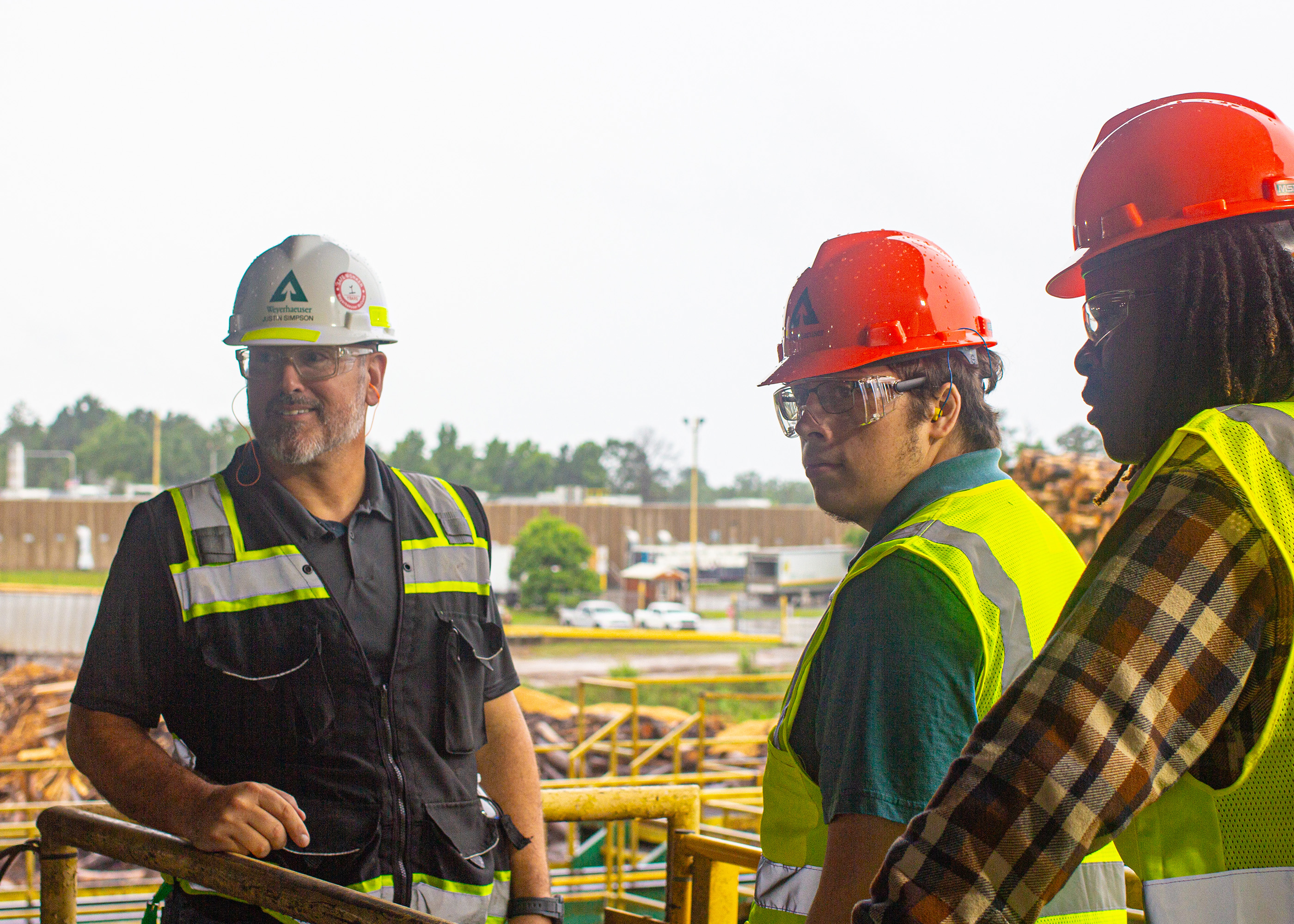
Justin Simpson, QC value manager, gives a mill tour to the intern group.
This summer, seven high school students from southwest Mississippi spent four weeks inside our McComb lumber mill in Magnolia, Mississippi, earning industry certifications, exploring every department and discovering career possibilities they hadn’t considered before.
The opportunity came through a partnership between Weyerhaeuser and Southwest Mississippi Community College. Students first completed a Basics in Manufacturing certification program during the school year, then applied what they learned through the summer internship, building workplace skills that will serve them wherever their careers lead.
Students attended classes two evenings a week throughout the spring, earning OSHA 10 certification while learning precision measurement, lockout/tagout procedures, forklift operation and other manufacturing fundamentals. The internship brought those lessons to life through department tours, job shadowing and hands-on activities focused on communication, teamwork and safety.
For Nathan Lawrence, the program arrived at the perfect time.
“I really didn’t know what I wanted to do after my football season ended,” he says. “My girlfriend heard about it and encouraged me to apply. It gave me a chance to try something different.”
Rashod Magee’s high school counselor provided a recommendation for the program after Rashod started thinking seriously about life after graduation.
Larkin Foxworth simply saw it as an opportunity worth exploring, while Ty’Ashyia Isaac was looking for a chance to step outside her comfort zone and experience something completely new.
Carleto Butler joined with a long-term goal already in mind: He hopes to own a construction business one day and saw the certification as a way to gain work experience while financially preparing for that future.
“This gives me the chance to get a good job, save money and learn more about the business side of things while I work toward starting my company,” he says.
LEARNING THAT SAFETY IS A MINDSET
While students expected to learn about manufacturing, many said the program’s biggest lesson was our approach to safety.
The internship devoted significant time to understanding hazard recognition, risk assessment and safety intervention — all well before students ever entered production areas. They learned that personal protective equipment is only one layer of protection, and that everyone has a responsibility to speak up when something doesn’t look right.
For Nathan, that lesson wasn’t always easy. One of the most challenging exercises had him practicing that kind of intervention with experienced employees.
“It was intimidating thinking about correcting someone who’s been doing the job for 20 or 30 years,” he says. “But they taught us that if you see something, you say something. Safety comes before everything.”
Students also completed mill-wide safety observations alongside members of McComb’s Safety Committee and took part in role-playing exercises that helped build confidence speaking up in real workplace situations.
Ty’Ashyia said the experience changed how she thinks about this kind of work.
“I didn’t realize how much safety goes into everything,” she says. “Everybody really looks out for each other.”
The intern group completed a Basics in Manufacturing certification program during the school year, then applied what they learned through the summer internship.
SEEING MANUFACTURING DIFFERENTLY
Touring every department — from the scale house and sawmill to the planer mill and shipping — offered firsthand experience to realize manufacturing involved far more than they expected.
Nathan was especially fascinated by the saw filer room after learning how much precision and expertise goes into maintaining saw blades that keep the mill running.
“It looked simple at first,” he says. “Then they explained how complex it really is, and I realized how much skill it takes.”
Another moment that stuck with several students wasn’t about equipment at all. Watching an experienced employee calmly troubleshoot a machine that repeatedly malfunctioned demonstrated the value of patience and problem-solving under pressure.
For Ty’Ashyia, the overall experience also broadened what she saw as possible for her future.
“A lot of girls my age are pointed toward careers like nursing,” she says. “Coming here and seeing women working throughout the mill made me realize there are a lot more opportunities than I thought.”
PREPARING FOR WHAT’S NEXT
Beyond technical skills, students spent time developing workplace habits through mock interviews, active listening exercises, teamwork challenges and performance coaching.
As part of their graduation presentation, the group even created an acronym capturing the lessons they wanted to carry forward into their careers, an exercise Carleto said reflected how much they had grown together over the four-week internship. The acronym spells out Weyerhaeuser as “We Empower You Everyday, Recognizing Hard Achievement, Encouraging Unity, Safety Excellence [and] Respect.”
Several students will continue working at McComb as summer employees, while others are pursuing trade schools, apprenticeships and different career paths. Rashod plans to attend the trade program at SMCC.
Looking back, every student agreed they would recommend the program to others.
Larkin has one piece of advice: “Bring a friend,” he says. “I wish I’d told more people about it.”
Rashod offered a simple message for future students considering the program.
“There aren’t many opportunities like this. Stay ahead of the game,” he says.
The intern group observes the manufacturing process in the mill.
BUILDING OPPORTUNITY
April Pittman, senior HR business manager for the Gulf South, helped develop the program with McComb’s leadership team and SMCC. Her goal was to tackle a problem faced by many of our manufacturing facilities: a notable shortage of skilled applicants.
“I’m thrilled with the program’s success,” April says. “Several students demonstrated exceptional leadership during teamwork and communications challenges, and they all actively engaged in every exercise. Three students were hired as summer help, and we’re hopeful they’ll ultimately transition into full-time employees. We’re excited for the next steps and future opportunities this program presents, and I hope it’s something that can be recreated at many of our other locations.”