When it comes to building durable, weather-resistant outdoor structures like decks, choosing the right wood product is critical. With designs pushing the span capabilities of traditional preservative treated sawn lumber, one may look to preservative treated engineered wood products (EWP) for a solution. Several preservative treated engineered wood products are available on the market. These include Weyerhaeuser offerings such as Treated Parallam® Plus PSL and StrandGuard® TimberStrand® LSL. Preservative Treated LVL and Preservative Treated Glulam are available from other manufacturers.
What Are They?
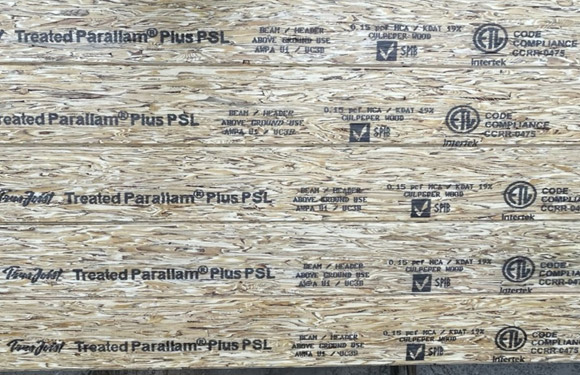
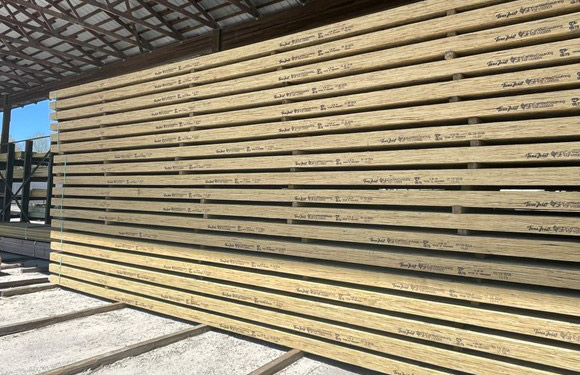
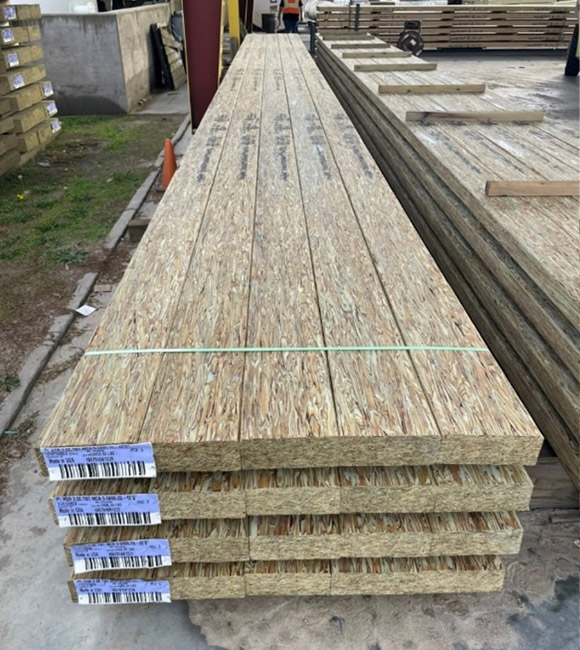
- Treated Parallam® Plus PSL (Parallel Strand Lumber) is Parallam® PSL that has been treated with preservatives at a Weyerhaeuser-authorized facility. PSL is an engineered wood product made from parallel wood strands bonded together with adhesive heat and pressure. Treated Parallam® Plus PSL is produced from southern pine and is treated using waterborne preservative chemicals (Copper Chromium Arsenic - CCA or Micronized Copper Azole - MCA depending on application) through a pressure process after manufacturing. The product is treated throughout its cross section and is then kiln dried after treatment to a uniform moisture content.
- StrandGuard® TimberStrand® LSL (Laminated Strand Lumber) is TimberStrand® LSL that is treated with zinc borate (ZnB) to provide protection against structural damage caused by wood-destroying insects and decay. TimberStrand® LSL Laminated Strand Lumber is manufactured from thin strands of Aspen up to 12” in length with all grain laid up primarily parallel with some cross direction for added strength and stability. TimberStrand® LSL utilizes a steam injection press which densifies wood fiber to create straight and consistent material. The zinc borate is added during the manufacturing process, so the product is treated all the way through.
- Preservative Treated LVL (Laminated Veneer Lumber) is manufactured from thin wood veneers layered and bonded under heat and pressure with adhesives incorporating preservatives, typically Propiconazole Tebuconazole and Imidacloprid (PTI). Douglas-fir is typically used, though southern pine may also be used.
- Preservative Treated Glued Laminated Timber (Glulam). Glulam is a stress-rated engineered wood beam composed of individual wood laminations (“lams”) bonded together with adhesives. Coastal Douglas-fir, hem-fir, or southern pine are commonly used species. Preservative treatment may be applied after gluing or to individual laminations prior to gluing, depending on the treatment system and wood species. Common preservatives for residential exterior applications include IPBC/Permethrin and Copper Naphthenate (CuN). Some glulam products used in exterior applications are manufactured from cedar laminations; these rely on the natural durability of the species and are permitted by code without preservative treatment.
Application & Durability
- Uses: The American Wood Protection Association (AWPA), founded in 1904, is the primary U.S. standards-writing body for wood preservation and treating. All product applications listed in the AWPA Book of Standards are developed through a consensus-based process by industry experts. These standards define acceptable product types, wood species, preservative systems, and retention levels to ensure performance for specific applications.
The AWPA developed the Use Category (UC) system (part of AWPA book of standards) to define end-use exposure conditions for treated wood products. There are five use categories based on level of exposure and expected performance. These range from dry interior above ground (UC1) to exterior saltwater exposure (UC5) applications. For exterior decks, consumers typically need UC3B (above ground) for joists and beams or UC4A (ground contact) products for posts. The Use Category system helps select appropriate preservative treatment for end-use.
Most commodity lumber and treated engineered wood products are included in the AWPA Book of Standards to comply with building codes. Products not included must obtain an ICC-ES Evaluation Report as an alternative path to code compliance.
- Flood Damage Resistant Products: Flood Damage‑Resistant Material, as defined by National Flood Insurance Program (NFIP), is any building material that can withstand at least 72 hours of prolonged floodwater exposure without significant damage or permanent swell. FEMA Technical Bulletin 2 and ASTM Standards E3075 and E3369 provide the test methods and criteria for determining flood‑damage resistance.
Treated Parallam® Plus PSL is effectively flooded during treatment and then kiln‑dried, removing the potential for permanent swell; if later flooded, it will dry back to its original dimensions. Treated LVL, which is dry‑treated and densified during manufacturing, does not undergo a flooded pressure process and can be susceptible to permanent swell. Based on its manufacturing process and ASTM E3369 guidance, Treated Parallam® Plus PSL meets the intent of NFIP, as do treated and untreated Glulam products.
Preservative Treatment Comparison
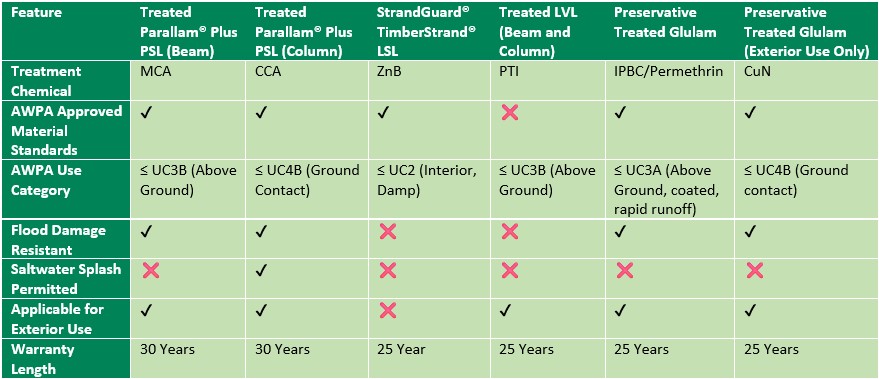
(click to enlarge)
Wet Service Conditions and Detailing
- Wet Service: Preservative-treated wood members used for decks and balconies are routinely exposed to rain and intermittent moisture. Under the National Design Specification (NDS) for Wood Construction Commentary (C4.1.4 and C5.1.5), wet service conditions occur when structural members are regularly exposed to rain, lack weather protection, and experience sustained or repeated moisture. These conditions require wet service design values to account for reduced strength and stiffness wood products experience at higher moisture contents.
- Protection, Finishes and Materials: Moisture protection requirements vary by product and application. Flashing or deck tape is commonly used on upward‑facing surfaces to enhance moisture protection. Some products require flashing or flashing tape (Treated LVL beams and columns) while others only recommend it (Treated Parallam® Plus PSL). Exposed members may be clad for aesthetics, but cladding must be detailed to allow drainage and ventilation. Systems that trap moisture should be avoided. In addition to aesthetics, some products require cladding for protection (Treated LVL columns) while other products such as, Treated Parallam® Plus PSL, do not.
- Material compatibility is equally important. Treated engineered wood products can decay when in contact with incompatible materials. For example, Treated Parallam® Plus PSL must not contact untreated or improperly used treated wood or existing construction showing decay. CCA‑treated Parallam® Plus PSL columns may be embedded in soil or concrete but MCA-treated Parallam® Plus PSL beams may not. On the other hand, Treated LVL must be fully isolated from concrete, pressure-treated wood, or other porous materials with an impermeable barrier.
To ensure long-term performance, always consult the manufacturer’s published literature and warranty documents to confirm product-specific design, detailing and installation requirements.
Final Thoughts
Understanding product offerings, use categories, moisture exposure are all important in choosing the appropriate preservative treated engineered wood product for your project and code requirements.
Treated Parallam® Plus PSL offers flexibility, durability, flood‑resistance in many exterior applications and is backed by a 30‑year warranty. Design and installation guidance is available in the Trus Joist® Treated Parallam ® Plus PSL Specifier’s Guide (TJ-7102).
For dimensionally stable sill plates or wall framing in damp environments, StrandGuard® TimberStrand® LSL provides termite and decay protection and is backed by a 25‑year warranty. See the Specifier's Guide for StrandGuard TimberStrand LSL (TJ-8100) for more.
For Trus Joist® technical support, contact (888) 453-8358 or techsupport@wy.com. For Trus Joist® product availability, contact your local territory manager WY Spec Center.