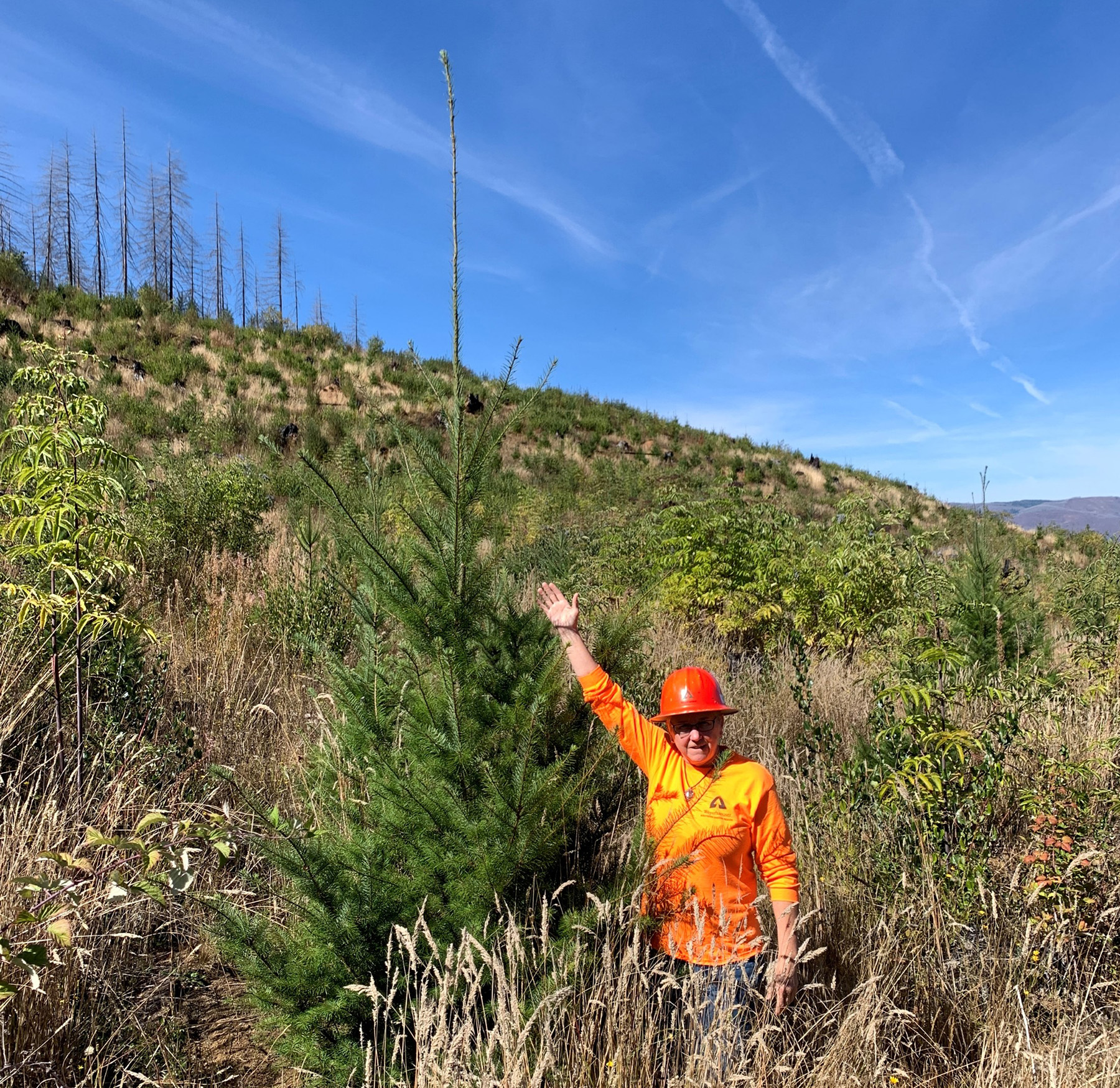
“We’re seeing beautiful stands of trees again,” says Debbi Dalrymple, a Springfield forester. “Dark green, fully stocked, vigorously growing. That’s what it’s really about — getting this land back in production.”
When the Holiday Farm fire swept across western Oregon during the historic Labor Day fires of September 2020, it transformed our Springfield tree farm almost overnight.
Fueled by hurricane-force east winds and exceptionally dry conditions, the fire raced across more than 170,000 acres, burning communities, closing highways and leaving behind a landscape of blackened ridges. Within Weyerhaeuser ownership, approximately 125,000 acres were impacted by the three Labor Day fires, including about 52,000 acres in Springfield that would ultimately require reforestation.
For Debbi Dalrymple, a Springfield forester who has spent more than four decades helping forests in this area grow, the devastation was deeply personal.
“It happened on such a massive scale,” Debbi says. “To look across the landscape and just see nothing but burn, ridge top after ridge top… I’d spent the last 20 years establishing and growing stands of trees. Having them erased by fire created a profound sense of loss.”
That loss quickly became the Springfield team’s mission.
“We were very driven to get those trees back on the landscape,” Debbi says. “It had to happen.”
Today, less than six years later, more than 21.4 million seedlings have been planted across the burn footprint — making the Holiday Farm fire recovery the largest reforestation effort in Weyerhaeuser’s history, surpassing even the replanting after the eruption of Mount St. Helens.
A stand of young trees with needles burned away by the Holiday Farm fire in 2020.
STARTING WITH A BLANK SLATE
The comparison is apt. Just like the volcano’s eruption, the fire destroyed established and new stands alike, erasing decades of work by the Springfield team.
“The fire wiped out all of our previously delineated stand boundaries and age classes,” Debbi says. “We basically had to start all over.”
Springfield foresters — including Debbi, Emily Caretti, Liam Patrick and Charlie Roselli — immediately worked with colleagues on the Science & Technology and Inventory & Planning teams to evaluate burn severity using aerial photography, historical records and on-the-ground assessments. They also studied the soil to determine where and how new forests could be established.
At the same time, the team worked on salvage of the burned timber — an effort that became one of the largest in company history.
Forest engineers laid out 260 harvest units on the tree farm to support both salvage and future planning. Those efforts included every Springfield team member in addition to company logging crews, an expanded contractor logging force, and forest engineering crews who built and repaired roads and replaced hundreds of fire-damaged culverts. Every acre presented different challenges, from standing dead timber to severely burned soils and damaged roads.
“It took so many people from so many different parts of the company,” says Jeanne Olson, Springfield area manager. “This project really showed what Weyerhaeuser is capable of when everyone comes together around a common goal.”
260 new harvest units supported both salvage operations and future planning.
PLANTING AT AN UNPRECEDENTED SCALE
As the burned timber was salvaged and the land was cleared, reforestation could begin.
Before the fire, Springfield typically planted about 1.4 million trees a year. Recovering from the Holiday Farm fire required several times that amount, year after year. Between 2021 and 2026, Oregon crews planted 28.5 million trees overall, including 21.4 million within the burn areas on our Springfield tree farm. To supply the increased seedling needs in Oregon, our Western Regeneration team boosted seedling production by 45 percent.
“I am so impressed by the efforts of our nursery leadership and their teams,” Jeanne says. “Megan Marleau, Anya Kuenzi and Sue Woodall were able to supply millions more seedlings than they typically produce. Their dedication, ingenuity and commitment to meeting demand have been truly remarkable.”
Of course, seedlings don’t plant themselves. While our four Western nurseries coordinated deliveries to keep planting crews supplied throughout the season, teams at our impacted tree farms relied on an expanded network of planting contractors to plant the seedlings.
“We had some awesome contractors who stepped up and did a really excellent job to help us plant four or five times as many seedlings as we usually do,” Debbi says.
Safety was another constant focus, especially as planting accelerated. Harvest crews, logging trucks, foresters and planting contractors were often working in the same areas at the same time, requiring careful coordination across every phase of the recovery.
“Elevated safety expectations, training and awareness got everyone home safe each night,” Debbi said.
Planting crews planted more than 21.4 million seedlings over the past six years. “We needed a truckload of seedlings a day,” Debbi says. “Normally we get a truck a week.”
WATCHING THE FOREST RETURN
Emily, Liam and Charlie were all instrumental to planning and implementing the first years of reforestation before moving to other roles in the company. Dylan Johnson, Niko Monaco and Devon Oesterling joined the Springfield team as foresters while planting was in full swing and worked closely with Debbi, Jeanne and Brad Moehlman, region forester.
“Despite being new to the company, Dylan, Niko and Devon jumped in, tackled every challenge that came their way and showed real perseverance in this unprecedented reforestation project,” Jeanne says.
The team managed planting, monitored survival, managed competing vegetation to ensure young Douglas-fir seedlings had the room they need to thrive, and completed land examination projects to develop more effective and cost-saving methods of meeting replanting goals.
In fact, some of the earliest planting efforts have exceeded expectations.
“The first year we planted actually had the best survival,” Debbi says.
With little competing vegetation and nutrients released by the fire, the seedlings established quickly.
Today, driving through the burn area feels very different than it did a year or two ago.
“I’m starting to not recognize where I am because it’s changing so much,” Debbi says. “There’s a tree in every planting spot. They’re healthy and growing. That’s my definition of success.”
A FUTURE FULL OF LUSH GREEN LIFE
Although the Holiday Farm fire recovery is already a historic achievement, the work continues. Young forests in the West require decades of management before they mature into the productive working forests that once covered the landscape.
“The scale of the effort in front of the Springfield team to restore the acres impacted by the fire was beyond comprehension,” says Shane Conway, vice president of Western Timberlands. “While I hope we never have to work through another challenge of this magnitude, the perseverance and grit that the team showed — along with their deep commitment to our core values of safety and sustainability — makes me incredibly proud to be part of the Western Timberlands organization.”
For everyone who helped work toward that future — from foresters and nursery employees to engineers, scientists, contractors and countless others across the company — the millions of seedlings now taking root across the Springfield landscape are more than a recovery milestone. They’re the beginning of a whole new forest full of life.