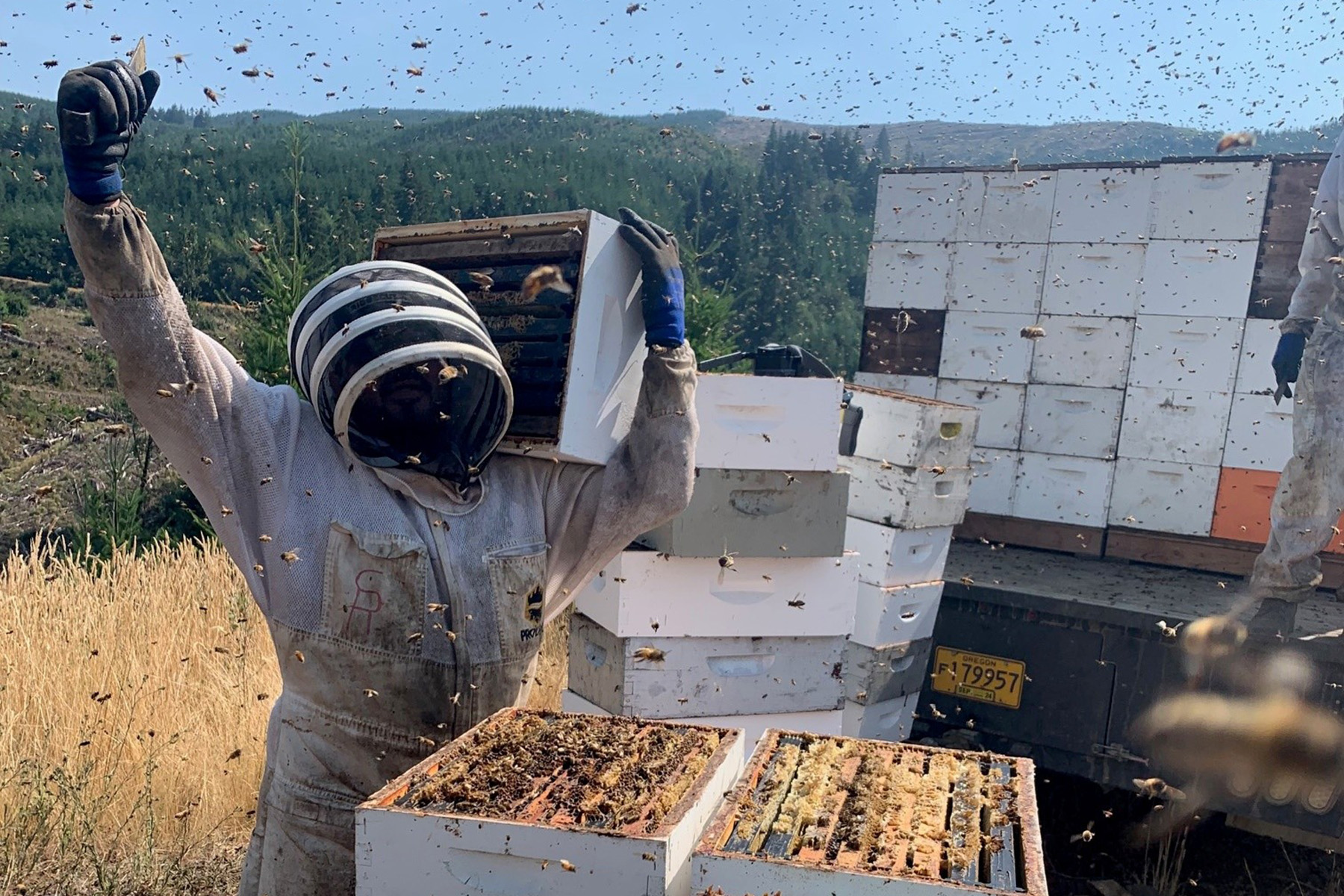
Every June, just before the native blackberries begin blooming in the Willamette Valley foothills of Oregon, beekeeper Devon Prescott readies his hives for their annual trip to the mountains. The journey starts after sundown when the hives are loaded onto flatbed trucks and rumbled through the night over gravel logging roads to preselected locations across our Snow Peak and Springfield tree farms. The bees spend their summers here, feasting on blackberries, fireweed and other native wildflowers and following blooms upward into the higher elevations.
Young forests are a pollinator’s paradise. For commercial beekeepers such as Devon, who owns and runs Prescott Honey Farms — one of the largest beekeeping operations in Oregon — Weyerhaeuser land provides the perfect summer habitat for his colonies. He has placed around 2,500 to 3,000 hives, representing about 20 percent of his bees, on our land this summer.
“This year is the most I’ve done,” Devon says.
Surging demand from Oregon beekeepers like Devon has helped make hive leases one of the fastest-growing areas of our specialty forest products program, which also includes noble fir bough sales and mushroom and berry harvests. From 2023 to 2025, the number of hive leases on our land increased from 2,230 to 25,491, the highest total in at least a decade. While the total financial contribution of these activities is small compared to other uses of our timberlands, the bees provide important environmental and social benefits that support healthy ecosystems and rural communities.
Bee Box Hive Leases on Weyerhaeuser land, 2020-2025
| Year | Bee Boxes |
|---|---|
| 2020 | 2,456 |
| 2021 | 2,581 |
| 2022 | 2,120 |
| 2023 | 2,230 |
| 2024 | 15,560 |
| 2025 | 25,491 |
“We have the ability to make our land available for pollinators,” says Lyndcy Pierce, land use manager for our Springfield tree farm east of Eugene, Oregon. “It’s not hurting us to have the hives out there, and I think it’s a good thing to do.”
A SWEET SITUATION
While small-scale beekeepers and hobbyists rarely move their hives, commercial operators such as Devon, who manages millions of honeybees, often follow migratory patterns in pursuit of the most abundant blooms or to provide pollination services to farmers under contract. Bees from Prescott Honey, for example, begin the year pollinating almond trees in California and spend the spring pollinating crops such as cherries, blueberries, carrots and radishes in the Willamette Valley before moving to the surrounding foothills and mountains for the summer. The nectar from each location infuses the honey with subtle but distinct floral notes. That’s why finding unique and productive apiaries, or “bee yards,” can make a big difference in the honey’s color, texture and flavor.
“I love finding new yards for the bees and seeing how moving them around makes different flavors of honey,” Devon says. “Adding the mountain yards in the late summer has been fun. It’s a challenge and an opportunity to produce a honey that not many beekeepers go after.”
Historically, finding locations for bee yards across the 1.4 million acres of timberlands we own in Oregon has been more art than science, with land use managers pointing beekeepers in the general direction of areas identified by our foresters. The best locations tend to be in forests that are 2 to 5 years old and with nearby water sources. Old log landings off spur roads can also be attractive, as can recently burned areas where fireweed grows tall and thick and produces a highly desirable light, mild honey.
“I’m not a bee expert by any means, but the beekeepers know what they’re looking for,” says Scott Marlega, land use manager for our Snow Peak tree farm east of Lebanon, Oregon. “I’ll issue an access permit, and they’ll spend a day reconning and send me coordinates of locations they like.”
Locations are approved and mapped only after land use managers confirm the sites don’t overlap with any of our current or planned forest operations.
Portable bee hives populate our Springfield and Snow Peak tree farms over the summer.
INNOVATING FOR APIARIES
New digital tools are making it easier and more efficient to identify potential apiaries — and are at least part of the reason for the recent increase in hive leases. Recently added map capabilities, which are layered onto our existing Field Maps application, allow employees and contractors to filter for specialty forest products and access location information from anywhere using their smartphones or tablets. Users can also filter for locations that meet specific criteria such as stand type, planned harvests and existing bee boxes, and then immediately see where new apiaries are likely to thrive based on current conditions.
Jeff Grogan, forest planner in our Southern Oregon Timberlands region, helped develop the mapping tool and underlying database and says the project emerged from an operational excellence initiative within Western Timberlands.
“We wanted to start ramping up our specialty forest products program as a whole,” he says. “And we really wanted to have a better way to track what we were doing, not only from a holistic standpoint but also for reporting at the end of the year.”
Lyndcy credits the new functionality, which is expected to be shared with other regions soon, with helping her increase the number of hive leases on the Springfield tree farm and more accurately track them.
“Instead of having them drive around blindly, I can now tell beekeepers, ‘I think this area would be good for your bees based on what you’ve told us you’re looking for,’” Lyndcy says. “They can go out and check specific spots, which saves them a ton of time.”
A view inside the bee boxes.
THE BUZZ AROUND BEES AND TREES
Forests provide other benefits to bees and beekeepers beyond an abundant supply of nectar and pollen. Remote apiaries reduce the interactions between bees and people, which typically increase during the summer as bees search for water — often in backyard swimming pools, pet bowls or fountains.
But that doesn’t mean forest apiaries are without challenges. Bears and raccoons are attracted to the hives for both the honey and the larvae and can cause real damage if undeterred. Electric fences present too much of a fire risk, so Devon and other beekeepers use motion-sensing cameras and alarms to keep watch over their yards.
“Sometimes they work,” Devon says. “And sometimes they don’t.”
On two separate occasions this year, Devon says he’s walked into one of his bee yards only to hear a snoring bear, sleeping under the trees after gorging on sweet treats from his hives. Both times the bear woke up and scrambled out of sight. Such encounters make for good stories but they’re relatively rare — and according to Devon, not enough to outweigh the overall benefit of having his hives in the woods.
“The mountains have been a really good solution for us,” Devon says. “I don’t know what I’d do if Weyerhaeuser didn’t let me put hives out there. It’s been good for my bees and my business.”