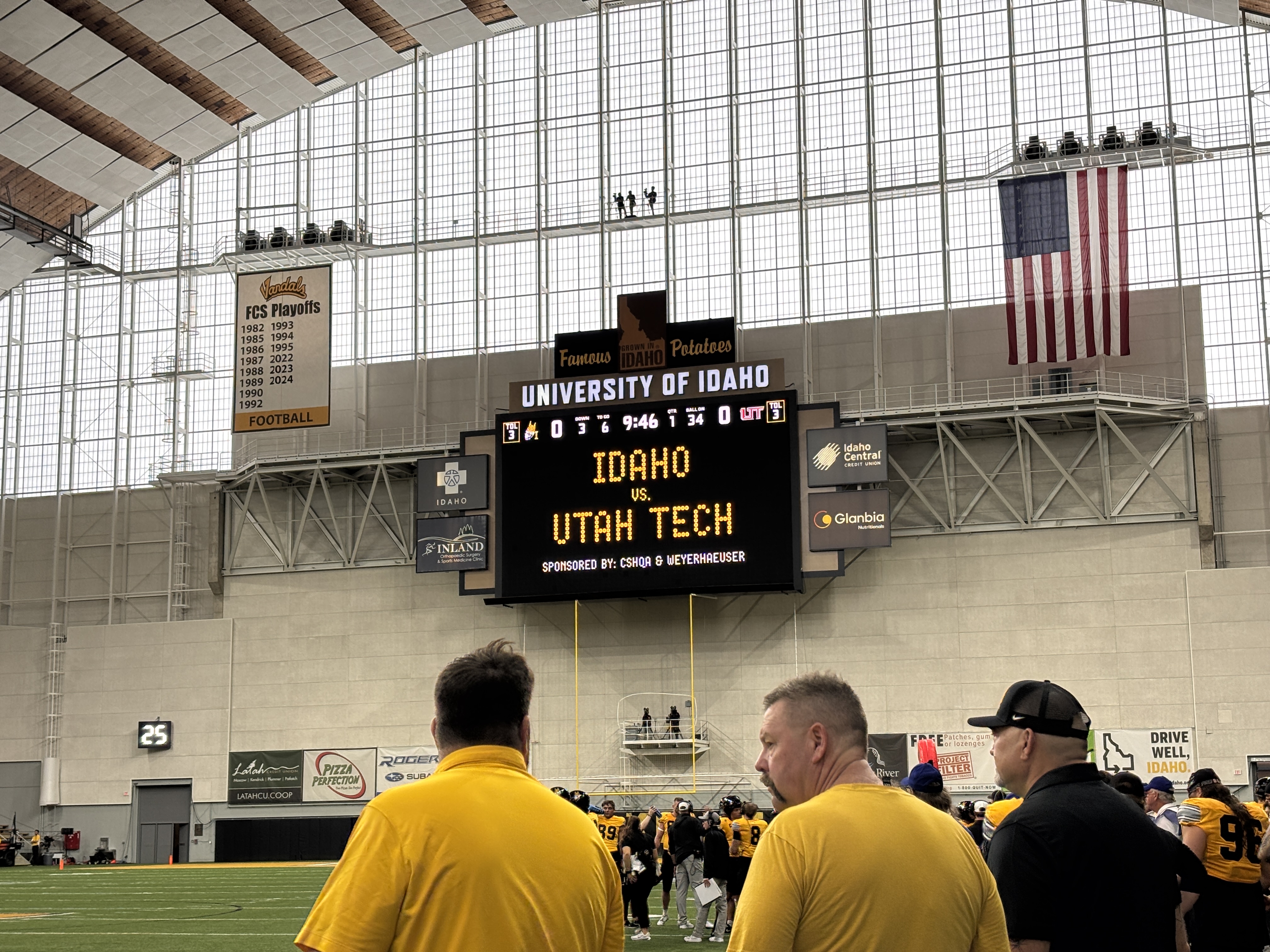
The view from inside the dome. “It’s cool that this is a university building — students see our product front and center on campus,” Josh says.
Fifty years ago, the University of Idaho took a bold step: covering its football stadium with what would become the world’s longest suspended wood roof. The result was the Kibbie Dome, an engineering marvel that turned heads far beyond Moscow, Idaho.
The dome’s distinctive barrel-arch design was made possible with Microllam® LVL (laminated veneer lumber) and a Trus Joist® TRUSDEK open-web system that paired wood with tubular steel. At the time, it was cutting-edge technology. Today, the structure still stands as a testament to the strength, precision and durability of engineered wood.
This past fall, the university marked the Kibbie Dome’s 50th anniversary with special events, game-day recognition and a commemorative video featuring Weyerhaeuser. The celebration highlighted not only the dome’s importance to the community, but also the innovative engineering that made it possible — leading back to a story of remarkable ingenuity.
Sky and others were invited onto the field to participate in the coin toss.
RAISING THE ROOF (LITERALLY)
Renee Strand, senior engineering manager, has spent nearly four decades with Trus Joist and Weyerhaeuser. When she first started, she worked alongside some of the engineers and wood scientists who helped design the Kibbie Dome.
“Those engineers mentored me early in my career, so it’s special to be a part of the anniversary celebration,” she says. “Their guidance not only developed my technical skills but also fostered a culture of innovation and problem solving that I strive to continue today with myself and my team.”
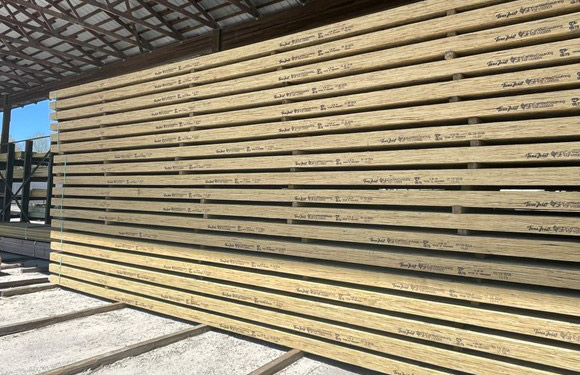
Trus Joist documented the dome’s construction in 1975 with a video that highlights the groundbreaking approach taken by the project team. The construction process began with crews assembling 80-foot-long roof modules on the ground, using jigs precisely curved to match the arch configuration required for the dome. Each module measured 12 feet 5 inches in width and 7.5 feet in depth and incorporated 12 Microllam LVL billets, each 24 inches wide and 80 feet long, to serve as the top and bottom chords of the trusses.
To complete the dome’s arches, three individual modules were connected together, forming one half of the arch. Each assembled half arch weighed approximately 45,000 pounds. Specialized cranes equipped with custom-designed lifting trusses hoisted and positioned each half arch, ultimately forming the full roof structure.
“It’s incredible to realize the entire roof installation was accomplished in just 24 working days,” Renee says. “It really underscores the efficiency and precision of the construction methods used, especially when exceptional accuracy was essential at every stage.”
The Microllam billets used in the dome’s roof were meticulously pre-cut and pre-drilled to tolerances of plus or minus 1/16th of an inch. This level of precision ensured that when each arch was elevated and positioned 150 feet above the stadium floor, it aligned perfectly with the adjoining sections for a seamless fit.
In addition to precision cutting, controlling moisture was vital to maintaining the strict 1/16th inch construction tolerance. The project's engineer of record expressed concerns that this was too tight of a tolerance for wood construction, estimating the billets could absorb enough moisture to swell by a cumulative total of 24 feet along the building’s length without adequate protection. The Trus Joist team addressed this challenge by developing a sealing solution that preserved the tight tolerances, effectively safeguarding the integrity of the dome’s structure.
Sky, center, with her kids in front of the dome. “The anniversary celebration was a reminder of how innovative our products truly are, and I was honored to be a part of it,” Sky says.
HONORING A LEGACY OF INNOVATION
For Weyerhaeuser, which acquired Trus Joist in 2000, the Kibbie Dome anniversary was a chance to celebrate an innovative legacy. We sponsored the University of Idaho’s 50th anniversary events and participated in a video that reflects on the original achievement (and that includes Renee talking about the dome’s engineering).
”We take pride in having contributed to the design and construction of the Kibbie Dome, an engineering marvel that illustrates the power of innovation and sustainability from inception to completion,” she says in the video.
Filming was supported by David Boyd, senior systems engineer, and subject matter experts such as Josh Dill, digital marketing manager for Wood Products.
“Knowing you have an engineered product that can meet a need that’s never been met before with traditional products — that just speaks volumes about the power of engineered wood,” Josh says. “And 50 years later, it’s still performing.”
The video was shared with the University of Idaho for its anniversary celebration. It was played during a football game at the dome and will continue to be featured at events and on the university’s social media channels throughout the season.
Click above to watch the video produced by the University of Idaho for the anniversary.
INSPIRING NEW GENERATIONS
Sky Eckert, territory sales manager, helped coordinate Weyerhaeuser’s role in the celebration.
“The Kibbie Dome was an amazing project back then, and it still is today,” says Sky, who’s also a University of Idaho alumna. “The university reached out to us and to the Boise-based architecture firm that worked on the original design. We were honored to sponsor the anniversary, from signage at the stadium to commemorative cups, and were even able to participate in a coin toss at the game.”
For Sky, being in Moscow for the events was a reminder of just how unique the dome is.
“Standing there in person, seeing the arches overhead, you just can’t help but feel proud,” she says. “It was great to represent the company and share that history with the community.”
That sense of pride is deeply shared by the University of Idaho — especially because of the dome’s strong connection to alumni.
“The P1FCU Kibbie Dome is an enduring point of pride for the Vandal family,” says C. Scott Green, president of the University of Idaho. “We’re grateful for the vision of U of I alums Art Troutner and Harold Thomas, co-founders of Trus Joist, who helped build the iconic roof that made the Kibbie Dome famous. Their legacy lives on through Weyerhaeuser.”
For Weyerhaeuser and our Trus Joist teams, the anniversary isn’t just about celebrating a single noteworthy structure. It’s about honoring a tradition of creativity, craftsmanship and collaboration that has shaped communities for decades.
“Problem-solving and innovation have always been at the heart of what we do,” Renee says. “The dome is just one example of how far that spirit can take us.”