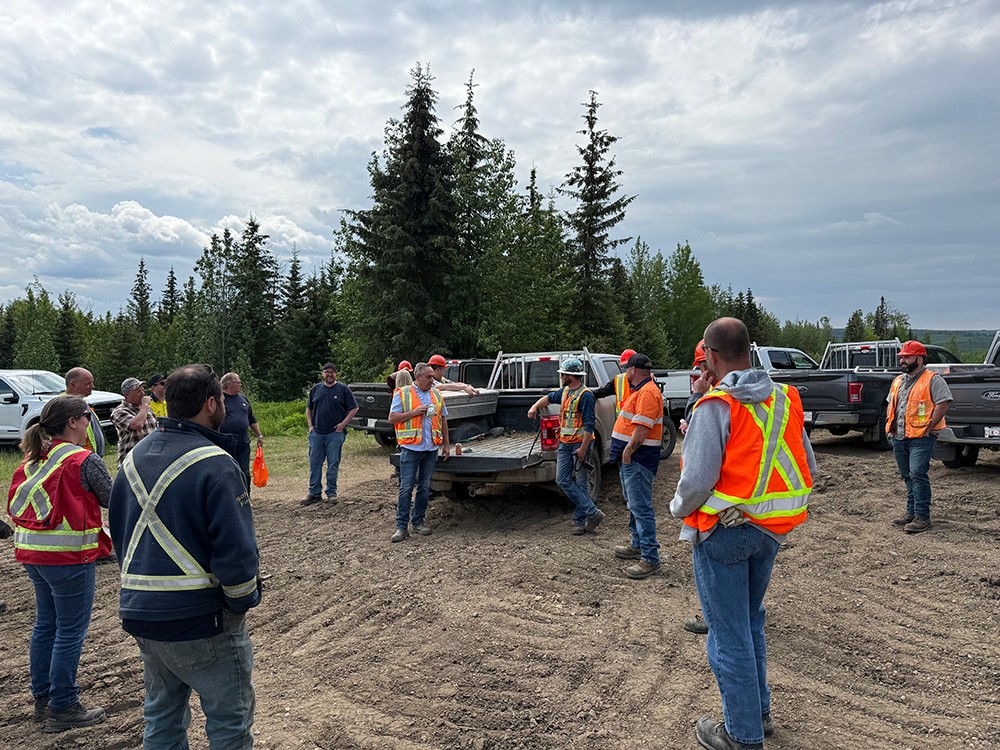
The group convenes during a field tour. “The pickup truck conversations were some of the most valuable parts of the event,” Ben says. “You really get a sense of people and their jobs and experiences in a way that’s not possible over the phone or on Teams.”
Road maintenance may not sound like the most exciting part of forestry, but it’s one of the most essential. Across our operations, tens of thousands of miles of haul roads need to withstand heavy equipment, extreme weather and year-round use — all while keeping costs manageable.
This summer, more than 40 road experts from across Weyerhaeuser gathered in Grande Prairie, Alberta, Canada, to explore new technologies that could help. Hosted by the local Timberlands team, the event combined field tours with classroom sessions focused on three surfacing additives Grande Prairie Timberlands has tested to stabilize road materials and improve long-term performance: Cypher R/S, EMC-1000 and Portland Cement.
“This was a great opportunity to leverage our internal expertise, share lessons across geographies and keep building our innovation pipeline,” says Ben Kamps, area manager for New England Timberlands and leader of the Roads functional team. “These are the kinds of conversations that lead to real change.”
BUILDING BETTER BASES
Most our haul roads are built using local in-situ materials, which often break down under long-term loading and wet conditions. That can lead to costly maintenance — from new gravel to machine hours. The three additives explored during the Grande Prairie event offer different approaches to solving the same problem: making existing roadbeds stronger, more water-resistant and more resilient.
“We’ve tried a lot of things here in Grande Prairie,” says Don Petteplace, roads coordinator. “The goal is to keep our roads usable for more days each year and speed up recovery after wet weather.”
Don and the Grande Prairie team first began experimenting with road stabilization products back in 2020. Since then, they’ve become one of the company’s leading innovators in the space, testing new products and building data around their effectiveness.
Their top three additives were able to do that in different ways. Cypher R/S bonds clay particles together into a flexible matrix, acting like a natural ‘cement’ that strengthens the road base without making it brittle. EMC-1000 forms a barrier against moisture, reducing infiltration and long-term degradation. Portland Cement, while effective in many contexts, requires curing and precise dosing to avoid cracking.
“Each product has trade-offs,” Don says. “So it’s about knowing your road material, your climate and your budget — and figuring out the right tool for the job.”
Don presents to attendees. “We were there to share what we’ve learned — but also to learn from everyone who came, and it was really successful in that sense,” Don says.
KNOWLEDGE THAT STICKS
Because of the team’s expertise, Grande Prairie was the natural choice to host a companywide surfacing workshop. Over two days, participants reviewed Don’s findings, watched live product demonstrations and traveled between field sites to see results firsthand.
“Every stop on the tour was a chance to dig into the details,” says Erik Holmstrom, Ontario Timberlands manager. “And when you’re in a pickup truck with someone from a totally different region, those conversations go deep.”
Those exchanges were exactly what the Roads functional team hoped to facilitate.
“This isn’t about finding one perfect solution,” Ben says. “It’s about sharing what works, piloting new ideas and using our scale to drive innovation.”
The group walks past a vibratory packer during the field visit. “It was amazing to see people from all over the company, all tackling the same problem in different ways,” Erik says. “Even if we ultimately find different solutions that work in our unique environments, we’re learning a lot from each other.”
FROM ALBERTA TO MAINE — AND BEYOND
One of the biggest benefits of the event was its cross-regional nature. Representatives came from four provinces and 17 U.S. states — including engineering leaders such as Stan Lubinus from North Washington.
“This was the first time I’ve seen so many road experts from across Weyerhaeuser in the same place,” Stan says. “We’ve learned a lot from Western Timberlands, but getting to see Canadian Timberlands in action was really valuable.”
Stan’s team plans to trial EMC-1000 this fall in Washington’s high-rainfall environment, despite having lower clay content than Grande Prairie — a key variable in the product’s effectiveness.
“Our weather may push the limits of what the product can do,” Stan says. “But we’re excited to test it and see what we learn.”
Other equipment on display included this Writgen reclaimer, motor grader and tank truck with stabilizer mix.
LAYING THE GROUNDWORK FOR FUTURE COLLABORATION
Participants left Grande Prairie with more than technical insights. They also brought back stronger connections, fresh ideas and a renewed commitment to continuous improvement.
“We all came away having learned something new,” Erik says. “And thanks to Don and his team, we’ve got real-world data to back it up.”
With additional pilots underway in the U.S. West and South, the Roads functional team will continue building out its innovation pipeline with a focus on surfacing cost, efficiency and long-term durability — an approach that could even benefit our environmental stewardship.
“Any time we physically move dirt, like during road building, there’s an increased chance that sediment will end up in our waterways, negatively impacting water quality or degrading forest soil health,” says Katie Cava, senior sustainability program manager. “By building longer-lasting and more durable roads, we reduce how often we’re in the forest working on them, which reduces the resources we need for maintenance and decreases risks to water quality and soil health.”
“The impact of better roads goes far beyond logistics,” Ben says. “It means less wear on equipment, safer travel and better use of our resources. That’s a win for all of Timberlands.”