When Weyerhaeuser ended our operations in Klamath County, Oregon, one of the things left behind was a Baldwin diesel locomotive that once hauled logs along the Oregon, California & Eastern railroad line to our sawmill in Klamath Falls.
“Back in the 1980s, the locomotive was parked on a siding right next to where the OC&E Woods Line rail-trail runs now,” says Joe Lagerstrom, communications director for the Train Mountain Institute in Chiloquin, Oregon. “Over time, they pulled up all the track that fed it, so it was stuck.”
The locomotive changed ownership a few times over the years but never moved — until the Train Mountain Museum acquired it in 2024.
“I had known about it for years,” says David Waterstreet, a Train Mountain board member who managed the locomotive’s 26-mile move from Klamath Falls to the museum. “I thought it would be a great addition to all the other Weyerhaeuser equipment we have up there.”
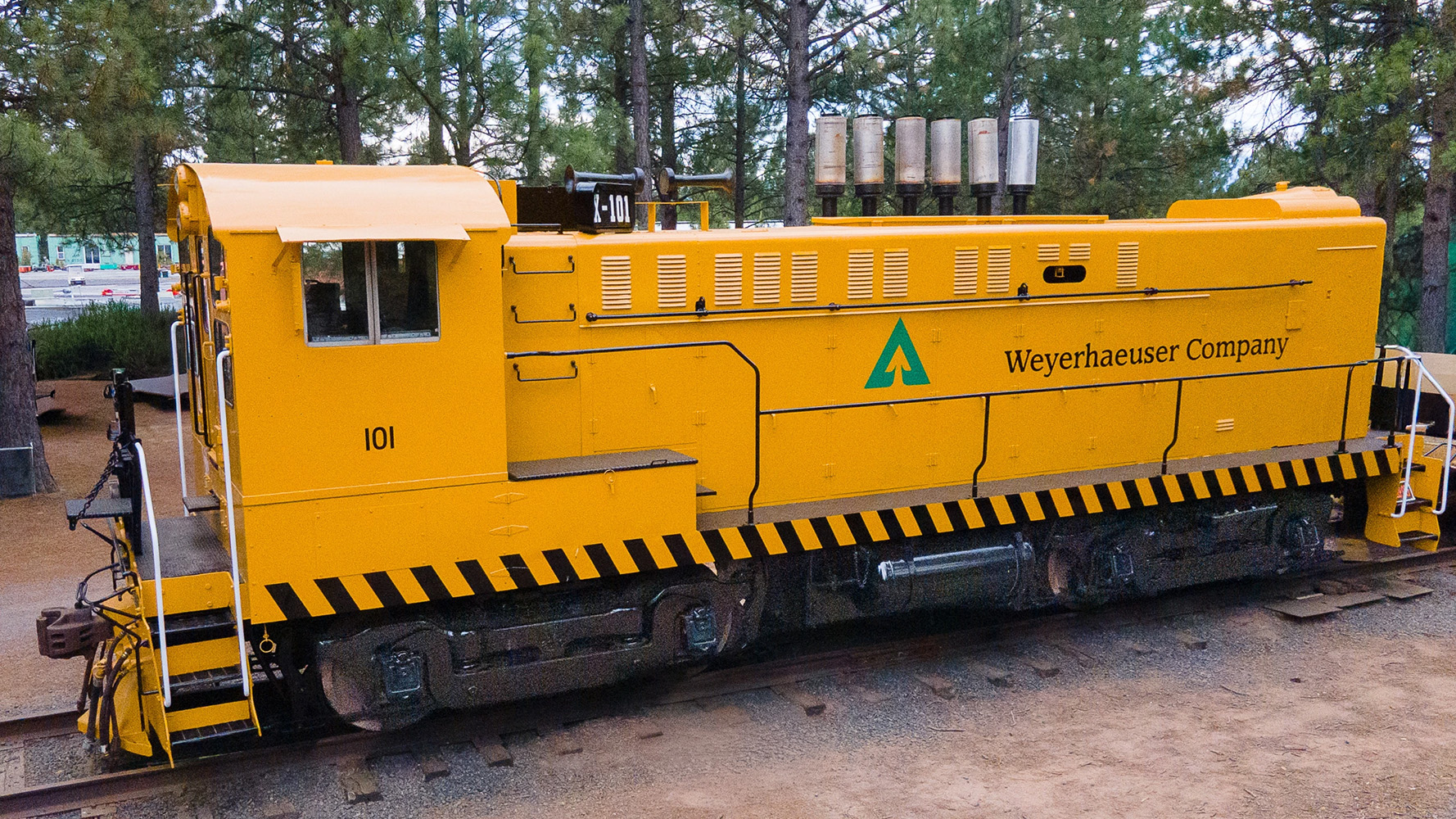
Now, freshly cleaned and painted, and with many of its fittings and features restored, the locomotive is on display at Train Mountain — a piece of Oregon timber and railroad history.
ENGINE OF HISTORY
Train Mountain’s mission is to educate the public about railroads and railroad history, with an emphasis on railroading in the Pacific Northwest. (They also host the world’s largest outdoor model railroad) Their collection includes several pieces of Weyerhaeuser equipment: a water tank car, three log bunker cars, a snow dozer and a caboose.
So when the opportunity arose to add a locomotive, Train Mountain jumped at the chance.
“I happened to be down at the state parks office, and the local superintendent asked if we knew anything about that locomotive,” David says. “Absolutely, I knew about it. I’d had my eye on it for Train Mountain. They were getting ready to scrap it, because it was getting to be an eyesore. When they asked if we wanted it, I immediately said yes.”
HEAVY LIFTING
Moving the locomotive was a challenge, as detailed in the video Train Mountain made about the project. Even if there had been rails to its location, the locomotive itself isn’t in working order.
“There was absolutely no way anyone was going to restore it to running condition,” David says. “It’s too old, with too many missing parts. If there was a piece of wire or copper piping that could’ve been extracted from it, it was gone. And the interior was kind of a shambles.”
Ness Campbell Crane, a heavy hauler company in Portland, signed on to move the locomotive. Frank Bartholomew, a Train Mountain member and a longtime friend of David’s, offered to sponsor the project. The parks department helped with initial cleanup, including taking the fencing down and clearing vegetation. The moving company used a 500-ton crane to lift the locomotive onto flatbed trucks for transport to Train Mountain. Because of the locomotive’s weight, it had to be partially disassembled, with the locomotive and its wheelbase — called the trucks — transported separately. Finally, the locomotive set off on its journey.
“We brought it right through Klamath Falls,” David says. “Then we made a left turn on highway 97 and away we went. That’s probably the fastest it’s ever moved in its life.”
At the other end of the trip, the repositioned crane set the locomotive in place: At the head of the line of cars that had also once been part of Weyerhaeuser trains.
“It’s the only consist — meaning a complete train — that we have on the property,” Joe says. “People think the locomotive is backwards because it seems to be facing the train rather than away from it. But that’s how Weyerhaeuser operated them, partly to spot the frequent track obstructions in the woods. And the water car was integral — it would dump water on the tracks right behind the locomotive to reduce the risk of fire.”
A FRESH COAT OF PAINT
After the locomotive was moved to Train Mountain, there was still plenty of work to do. Though making the locomotive run again wasn’t possible, the museum took on considerable cosmetic repair, environmental cleaning and restoration to make the locomotive look good as new.
This part of the project was accomplished by Chris Fussell, a railroad preservationist from Portland, Oregon. Chris and David stripped off all the old paint and rust and applied several coats of fresh paint, including trim and stenciling, all chosen to make it look the way it would have when it was part of our operations. The painting took two sessions, one in October 2025 and the other in June 2026. Another friend of David’s made a replacement builder’s plate.
“Builder plates go on the locomotive with the builder’s name, the serial number, the date and where it was made,” David says. “They’re collector’s items, but we couldn’t find the original anywhere. So, we made a new one.”
TELL THE STORIES
While there’s still work to be done, such as detail work inside the cab, Train Mountain is getting the locomotive as close as possible to how it looked when it was operating.
“We really went as far as we could with it,” Joe says. “One of our members, Steve Panzik, project historian, tracked down the horns, the bell, and other missing accessories. It’s as accurate as it can possibly be for a cosmetic restoration.”
That attention to detail and accuracy is a cornerstone of the Train Mountain Institute’s educational mission.
“Everything on this train was used by Weyerhaeuser from the 1950s up to the early 1980s,” David says. “It’s an integral part of the logging history of Klamath County.”
News of the locomotive’s completed restoration was shared in Train Mountain’s member newsletter, the Gazette, in June with previous issues chronicling the project’s progress.
Looking ahead, Train Mountain Institute hopes to continue the work by cosmetically restoring the remaining rolling stock in the Weyerhaeuser consist, helping preserve the full train as a visible connection to the region’s timber and railroad history. There are also several other rare Weyerhaeuser rail artifacts in their collection that help tell the industry’s story.
“I just want people to know that it’s there,” Joe says. “We’re open seven days a week, and anybody’s welcome to come on in and have a look. Our 40th anniversary is next year, as is the 200th anniversary of railroading in America, and I’m trying to gather stories about what we have here. Rail fans are always interested in companies like Weyerhaeuser that have operated their own railroads.”