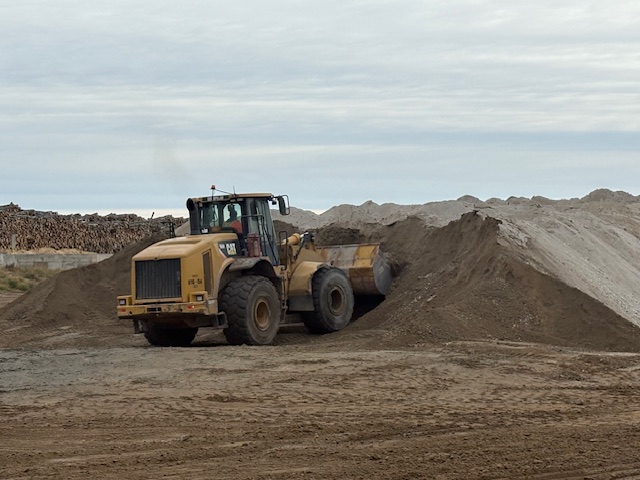
A bulldozer moves ash in the Hudson Bay log yard. The team is still working to reduce two years’ worth of accumulated ash, and their creative solution earned the site a 2024 Wood Products Award for Most Impactful Innovation.
When our OSB mill in Hudson Bay, Saskatchewan, faced the challenge of disposing of two years’ worth of ash, the team developed a solution inspired by similar work at our OSB mill in Edson, Alberta, seven years earlier, when Edson had successfully supplied local farmers with ash as an agricultural additive to neutralize acidic soil.
Until 2022, Hudson Bay disposed of ash residuals in a local landfill. However, changes in provincial regulations required expensive treatments to neutralize its high pH, which can be as caustic as lye or lime.
ASH: A BY-PRODUCT OF MAKING OSB
At our OSB plants, logs are chipped into strands, then dried, blended with resin, aligned in a uniform direction in mats, and pressed and heated to form panels. Aside from planned downtime, mills are designed to operate 24 hours a day, seven days a week.
Like many of our OSB plants, Hudson Bay burns wood waste such as sawdust and fines to fuel the furnaces that heat its large press. It’s an efficient way to use a manufacturing by-product, but the furnaces produce one of their own: ash. And as the mill looked for alternatives to the landfill, the ash was piling up on-site — eventually exceeding 9,000 tons.
“We had a real problem as the ash accumulated,” says Kendall Kowalyk, safety manager. “It hardens like concrete when exposed to moisture, and we store it in a bunker to prevent it from leaching into groundwater. We ended up with so much ash we had to build another bunker.”
Ash is loaded onto a trailer for transport to the farm fields near Hudson Bay. In Hudson Bay’s case, the ash mainly comes from poplar, aspen and various understory trees.
SEARCHING FOR A SOLUTION
As Ashley Cressman, site safety coordinator, explored alternative uses for the ash, she reached out to SYLVIS. The Canadian company specializes in residuals management, from research to disposal — including sustainable disposal through agriculture.
Ash can neutralize acidic soils as a liming agent, and it can be a good source of calcium and potassium when used in moderation and with regular soil testing. That in turn improves crop yields and reduces reliance on other fertilizers.
“Ashley worked with SYLVIS to build a plan, conduct appropriate testing and supply the ash to local farmers,” Kendall says. “It was certainly a more environmentally friendly option than disposal at the landfill.”
Ash helps balance soil pH while providing some key nutrients, making food crops like canola healthier and more productive.
NAVIGATING BETWEEN A ROCK AND A HARD PLACE
Getting the ash ready took some work. Since it had been exposed to rain, it was rock hard. It needed to be processed into fine material suitable for a manure spreader.
“We found a contractor with an excavator equipped with a mulcher-like attachment to break up the ash,” says Cole Dancsok, who supports the mill’s health, safety and environmental team and has overseen testing to fill in for Ashley during her maternity leave.
The first shipments to a local canola farmer began in October 2024. Since then, the mill has saved landfill fees of nearly half a million Canadian dollars annually — and helped contribute to a far more sustainable solution. The nutrients and carbon captured in the ash are mixed with the soil to provide agricultural benefits rather than being emitted into the air or disposed of in a landfill.
“It’s been working great,” Cole says. “It’s nice to finally have a solution that works for us, farmers, our community and the environment.”
“We do a great job of using nearly all the trees and minimizing our footprint by using our by-products in useful ways,” says Bonnie Choumont, technical manager. “This solution is an example of our ongoing commitment to reducing our environmental footprint.”
Our Corporate Sustainability team agrees.
“This project is a great example of our OpX culture, where we look at our current processes and ask, ‘How can we do this better or differently to create value?’” says Chad Leatherwood, senior sustainability transformation manager. “This project not only creates monetary value for the company by finding a market for ash; it also advances our sustainability goals by reducing waste, conducting appropriate testing before selling ash for beneficial use, maximizing the use of every log that enters our facilities, and applying innovative thinking to create a dual win for the company and community.”