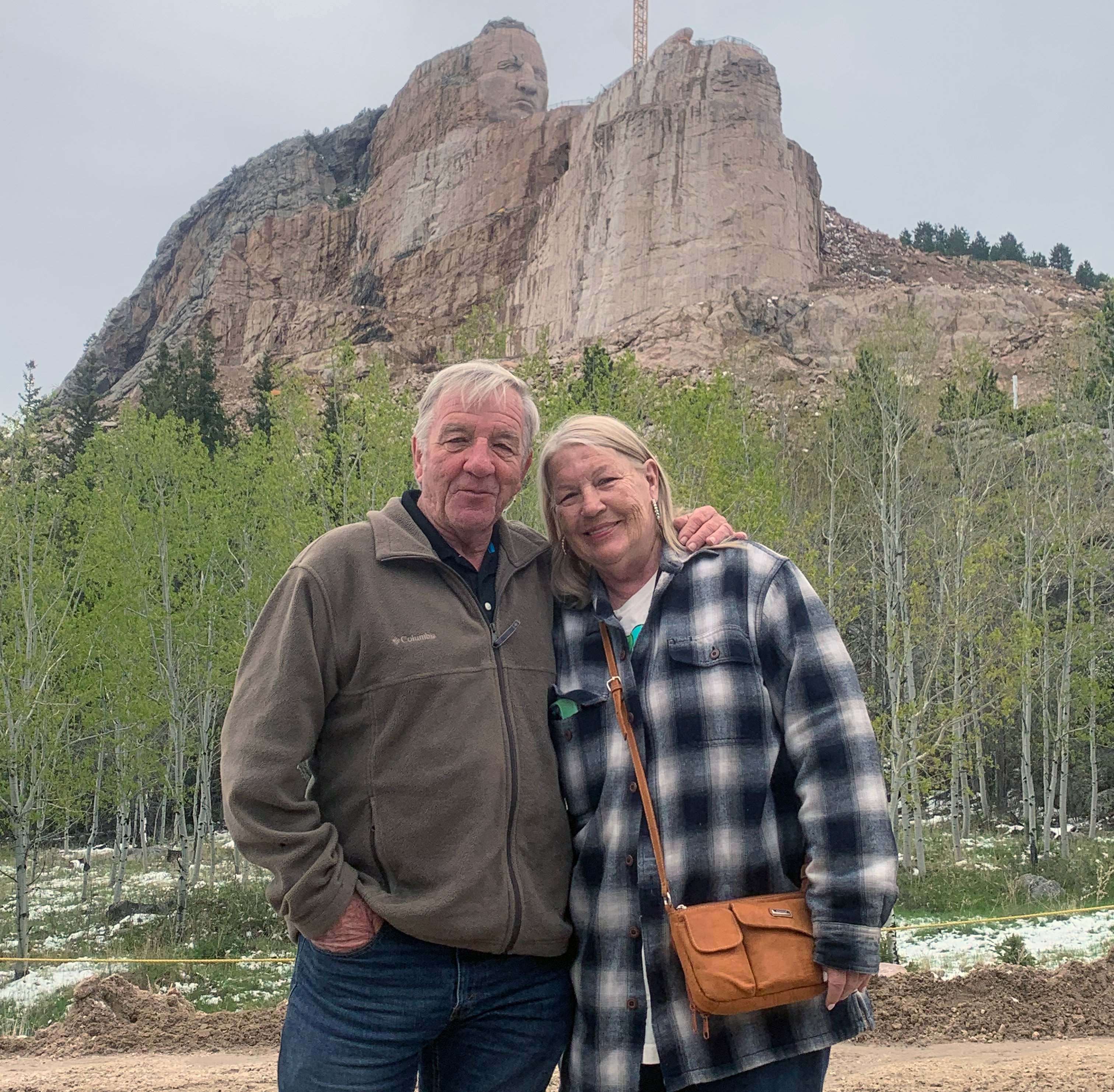
Jerry Goforth and his wife, Kathy, while on vacation.
On May 4, Jerry Goforth, saw filing manager, celebrated an impressive 50 years at our lumber mill in Philadelphia, Mississippi.
Jerry first honed his skills at a small saw shop in nearby Meridian, Mississippi, repairing saws for local businesses. When that shop moved, Jerry sought work at our Philadelphia lumber mill. The 21-year-old was hired on the spot. It was hard labor, and he was paid $1.95 an hour.
“Weyerhaeuser opened the door and put me to work, and I’ve been here ever since,” Jerry says.
Over the course of his career, Jerry has worked in a variety of roles in every department at the mill, building deep technical expertise, especially in saw filing and machine alignment.
“Some people find the maintenance work involved with saws tedious, but I enjoy it,” he says. “When I was a saw filer and wanted to understand how the machines operated and what I could do to make them run better, I was able to learn how to fix the saws, too. That’s how I started working with maintenance, and I still work with them today.”
SHARING A SPIRIT OF COLLABORATION AND REPLICATION
As a saw filing manager, Jerry leads a strong, collaborative team. Team members will come to Jerry for his vast knowledge, and as the oldest and longest-tenured employee at the mill, he relishes the opportunity to mentor both seasoned workers and new hires.
“When an issue arises, employees will tell me, and we’ll address the problem together,” Jerry says. “I don’t have all the answers, so sometimes we learn something together.”
Jerry says that whenever he visits our other mills in the Gulf South region, he tries to learn something that he can implement at Philadelphia.
“I always try my best to pick up something new,” he says. “If I see they’re doing something better than we are, I bring it back home to replicate at Philadelphia. That’s just the way we work. I love how innovation and ideas are shared at Weyerhaeuser.”
CONTRIBUTING TO SAFETY EVOLUTION
While Jerry has seen many changes during his tenure, he cites the evolution of safety practices at the mill as the most significant. When he started in the mid-1970s, safety protocols were minimal. Hard hats and steel-toed shoes were required, but safety glasses and ear protection were not widely used. The prevailing culture at the time prioritized keeping the mill running at all costs.
“That changed many years ago,” Jerry says. “If there’s a need for someone to enter the process, we shut the equipment down and we lock it out properly. Today, injuries occur much less frequently than they did when I first started.”
He credits a number of things for the shift, including our comprehensive safety protocols, regular safety meetings, mandatory use of protective equipment and introducing a Job Safety Analysis for every machine center. When JSAs were first introduced, Jerry was tasked with writing many and making sure the step-by-step safety procedures were followed by all employees.
“That was a challenge, but I love the safety aspect of the job,” he says.
Jerry says the Philadelphia mill is where our current RADAR system originated. This feedback tool allows employees at every machine center to document issues, which are then reviewed and addressed by management.
“We keep one at every machine center, basically to know what’s going on and get the operator’s input,” Jerry says. “We’ve found it to be really useful over the years.”
ALWAYS GROWING AND LEARNING
Data collection and analysis are a major part of Jerry’s job today. He uses data to troubleshoot issues and experiment with new methods to improve efficiency. And he makes time for regular team meetings in order to foster a sense of ownership and accountability among employees.
“When I get to the mill for the night shift, I spend some quality time with the saw filing team,” he says. “I ask them how everything is going and how their night has been. It’s an open conversation for any issue they may have, and they usually have some. That’s OK. That’s what I’m there for.”
Technological advancements have dramatically transformed the mill over the years. When Jerry began, much of the work was done manually. Today, nearly everything is automated, reducing the physical demands of the job and enabling employees to work safer, longer careers.
“Back in the old days, you were given some tough tasks when you started with the company,” Jerry says. “If you made it a couple of weeks, they figured you’d probably stay. If you didn’t, you’d leave on your own. I didn’t give up, because hard work didn’t bother me. I’ve found Weyerhaeuser to be a great company to work for.”
Jerry attributes his long tenure to Weyerhaeuser’s supportive environment, strong leadership and investment in its people, including educational opportunities. In fact, Philadelphia even had a school when Jerry first started. Employees could complete their schooling while working.
Jerry has built lasting relationships with colleagues, some of whom have worked alongside him for decades.
“I really value the friendships I’ve made here,” Jerry says. “Weyerhaeuser has definitely made me a better person over the years. I’ve had to challenge myself in a lot of different roles with the company, which has given me more confidence.”
THE END OF AN ERA
Jerry plans to retire this year, and he looks forward to spending more time with his wife, who he says has steadfastly supported him throughout his career. Though he says retirement is bittersweet, Jerry wants to help his son with his business and travel with his wife.
“I still appreciate that Weyerhaeuser opened the door for me 50 years ago,” Jerry says. “I’ve done everything I can to make the Philadelphia mill profitable, and I’ve done it safely. I’m proud of the products we make. We have truly been blessed, and I’m going to leave here happy and feeling good.”