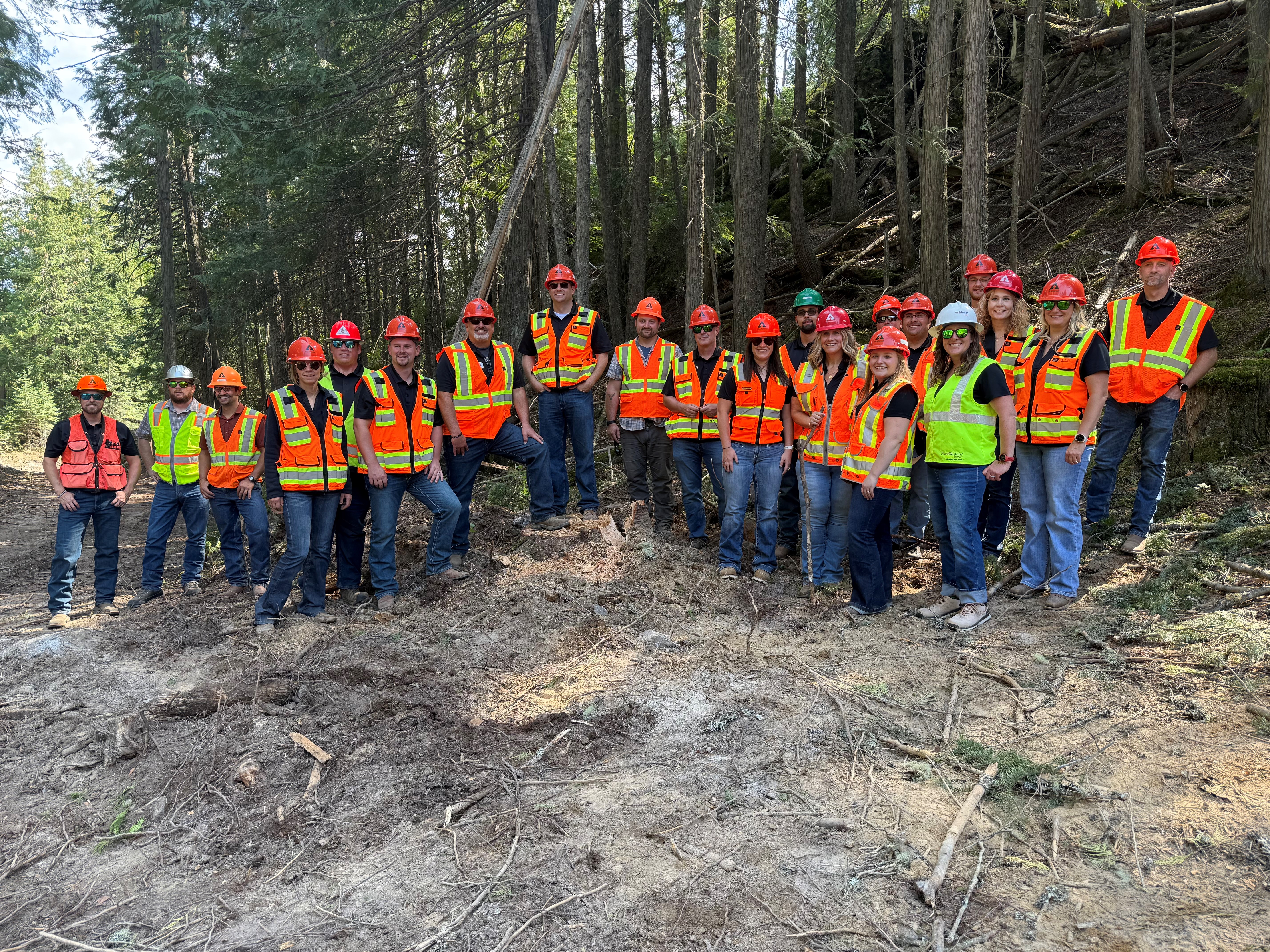
Wes Gadwa, far left, with REAL Montana Class 6 participants and guests at a timber harvest site.
Weyerhaeuser employees across the Northwest are stepping into a new generation of leadership development through three powerful state programs: Resource Education and Agriculture Leadership, or REAL, in Oregon and Montana, and AgForestry in Washington.
Though each program is unique, they share a unifying purpose of developing informed, connected and collaborative leaders who can strengthen natural-resource industries from the ground up. Participants build knowledge, experience and valuable cross-industry relationships.
For our employee participants, and for Weyerhaeuser at large, the programs also represent something deeper: a tangible investment in leadership and in the long-term resilience of the industries and communities we serve.
For Shauna Dunn, REAL Montana “reinforced the emotional awareness and teamwork needed to be an effective leader — one who can collaborate thoughtfully, even when interests compete.” Here, Shauna and her fellow REAL Class V participants go on a tour in Vietnam.
CONNECTING ACROSS INDUSTRIES
Kyleigh Gill, Oregon and Montana PR manager and a REAL Oregon Class 8 graduate, says the program immediately broadened her perspective beyond forestry.
“It’s easy to get siloed within your own industry,” she says. “REAL Oregon allowed me to learn about all the natural resources in our state, from fisheries to agriculture and ranching.”
The cross-industry exposure works both ways. Many of Kyleigh’s classmates were stunned by how heavily regulated forestry is.
“They couldn’t believe what our foresters deal with day to day,” she says. “It was eye-opening for them and validating for us.”
Our participants learn alongside fishermen’s associations, ranchers, growers, producers, agency leaders and association staff, building a network that extends well beyond the five-month program. They lean into community-level engagement that includes serving on boards, volunteering, learning how to run effective meetings and communicating during a crisis.
“There’s a whole day on what it means to be a good board member,” Kyleigh says. “It encourages us to get involved locally, which eventually trickles up into lobbying around the policies that affect our industry.”
A REAL Montana Class V field session explores forest management, wildfire strategy and mill operations across the state.
LEADERSHIP ON A LARGER STAGE
In Montana, REAL participants engage in a rigorous two-year program that blends leadership development, policy exposure and immersive field sessions.
“It was an amazing experience,” says Shauna Dunn, Panels safety liaison, who served as class president of REAL Montana Class V, which wrapped up in 2024. “I’ve always been passionate about leadership, and this program reinforced how essential servant leadership and adaptability are — especially in complex, real-world environments.”
REAL Montana cohorts travel widely — from natural resource hubs across the state to Washington, D.C., and an international seminar. For Shauna, the seminar in Vietnam left an especially lasting impression.
“We witnessed extraordinary resilience in people who viewed challenges as opportunities for growth,” she says. “It was a powerful reminder of the importance of maintaining a growth mindset, both as a leader and as a person.”
SEMINARS ON THE HOME TURF
Our Montana teams also host REAL participants in the field for hands-on experiences.
Wes Gadwa, engineering manager and REAL Montana Class VI participant, helped host a ‘Timber and Culture’ seminar in Kalispell, which covered everything from market conditions and wildfire management to Indigenous cultural training and value-added manufacturing. The seminar also included tours of an active harvest site, the F.H. Stoltze Land & Lumber Company sawmill, and our Columbia Falls MDF plant.
Wes invited Weyerhaeuser employees to speak, including Betsy Earls, public affairs manager (and REAL Oregon Class 3 graduate), and local raw material leadership. He also invited representatives from Native American and Indian relations to explain how the relationship between local tribal groups and the forestry industry has changed over time.
“That discussion peeled back layers to show how our Montana timber heritage continues to define our state and way of life,” he says. “Our guest speakers from local tribes and Indigenous groups share the values of having a deep relationship with the land and finding balance with natural resource utilization.”
Colin Towne and coworker Megan Schultz, logistics manager, on an AgForestry trip to Washington, D.C.
EXTENDING THE NETWORK IN WASHINGTON
Washington’s AgForestry Leadership Program parallels REAL’s goals with an 18-month curriculum that blends leadership training, public policy immersion and cross-industry education.
Colin Towne, lead forester at our Longview tree farm, says the program reshaped how he thinks about leadership and influence.
“I initially got into AgForestry with the goal of bettering myself,” he says. “But I walked away realizing my growth doesn’t just impact me, but also my team — because they deserve an excellent leader. That mindset shift has stayed with me.”
He says AgForestry’s structured leadership tools were just as impactful.
“Some people may be natural leaders, but there’s also a tangible skillset you can learn,” Colin says. “How to communicate, how to give feedback, how to navigate conflict — those tools changed how I show up at work. There’s a large presence of AgForestry graduates within Weyerhaeuser, and we each gain a network of people across the state we can call up for perspective or support. That’s an incredible asset that strengthens our whole industry.”
STRONGER INDUSTRIES, STRONGER COMMUNITIES
All three programs require a significant commitment — time away from home, long sessions and deep reflection — and Weyerhaeuser supports participants every step of the way.
“When the company invests in people through programs like this, it sends a powerful message: ‘We see you as a leader,’” Shauna says. “And in return, we come back stronger — ready to step into new roles, mentor others and lead with greater confidence and perspective.”
Ultimately, these regional programs do more than develop individuals. They help strengthen the broader natural-resource landscape in each state by cultivating informed, collaborative leaders who can navigate change and support resilient, sustainable communities.
“All of these industries play a vital role in our way of life,” Shauna says. “Sustainable production matters everywhere, and programs like this prepare us to lead responsibly and support the communities that depend on this work.”