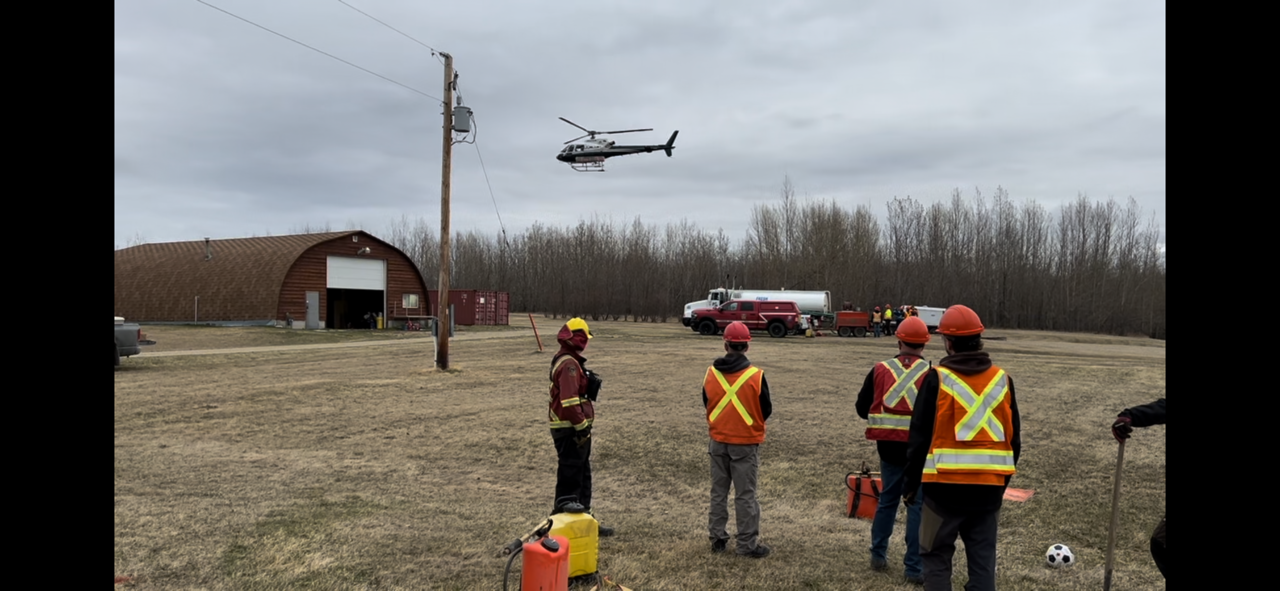
Our Pembina Timberlands team trains on filling a portable water bladder, or pumpkin, as part of their wildfire preparedness planning.
As winter loosens its grip across our Canadian timberlands, another season quickly comes into focus — wildfire season — and spring offers a critical window to transition and prepare for drier conditions. Across regions, our teams update plans, test equipment, refresh training and reconnect with partners. The goal is simple: be ready to act before the first spark.
“Spring wildfire preparedness is about prevention first and response readiness second,” says Jeff MacKay, general manager for our Pembina Timberlands team in Drayton Valley, Alberta.
That readiness doesn’t come from any one person or team. It’s built long before any fire ever hits the landscape through coordination across roles, regions and internal and external relationships.
“Our maps tend to be more detailed and up to date than what the agency has available, so that’s really helpful as we coordinate,” Michael says.
ONE SYSTEM, MANY ROLES
Wildfire preparedness touches nearly every part of the business, from field operations to planning and leadership. And since we operate on public land in Canada, wildfire response is always a shared responsibility with the provinces.
Each year, teams develop and refine a fire control plan, which provides a detailed playbook outlining how our resources will coordinate with provincial agencies in both prevention and suppression.
“Having our plans vetted and understood before we’re in the midst of a chaotic fire event is important,” Jeff says.
Jim Kalan, Pembina planning forester, helps connect those dots. Acting as a key liaison between Weyerhaeuser and provincial agencies, he’s often the first point of contact when a fire starts — and a central hub for information flow.
“When we get that call, we’re getting the basics — location, size, fuel type,” he says. “We share what we have on the landscape, like log decks, active operations and planting camps, so everyone has a clear picture of what assets are most at risk right away.”
That shared visibility is the result of years of refinement. What started as an informal approach has evolved into a more structured preparedness program.
“This is our fourth year with a formal program,” Jim says. “Every year we’ve made changes, testing new ideas alongside what worked before and building on that.”
For leaders like Michael LeBlanc, Timberlands general manager in Hudson Bay, Saskatchewan, that system-wide coordination is essential.
“Wildfire preparedness affects everything we do, from harvesting to hauling to forest management,” he says. “The sooner we have plans in place, the better.”
Pembina team members train on fire suppression.
FROM PREPARATION TO RESPONSE
Provincial meetings provide not only updates on fire activity, forecasts and resources, but also opportunities to reinforce the relationships that are especially critical during emergencies.
“You need trust to work together effectively,” Jeff says. “You don’t want to try to establish relationships from scratch during an emergency."
When fires do occur, that trust and preparation is what allows teams to move both quickly and efficiently. Michael saw this firsthand during a late-season event in 2021, when multiple fires ignited around Hudson Bay in a single weekend.
“There were nine starts and limited agency resources,” he says. “So our staff and contractors built fire lines and supervised equipment on the ground while the agency focused on aerial response. It was a coordinated effort, and it let the province focus their resources on larger fires.”
In those moments, our teams become an extension of public wildfire response. This dynamic also played out during the 2023 season in Pembina Timberlands, when a six-week-long fire spanned roughly 500,000 acres in Alberta.
“We had staff and contractors participating in suppression activities,” Jeff says. “We were safe and successful because of the training and preparation we had in place.”
These fire events also proved the importance of deep local knowledge and strong communication.
“You need to understand the land, the fuel types, where equipment can and cannot go — and communicate constantly about what the fire is doing and what comes next,” Michael says. “We become another resource for the government. And when provincial resources are stretched, that makes a real difference.”
The Pembina fire approaches the town of Drayton Valley in 2023. Hours later the town was evacuated.
REDUCING RISK BEFORE IT IGNITES
Internally, teams follow operating guidelines that adjust work based on fire hazard levels, monitoring conditions and updating operational plans accordingly.
“Every activity is classified by risk level,” Jim says. “Each risk level has modifications or restrictions on when work can happen. If conditions are high risk, for example, we might shift work to early morning hours or shut certain activities down altogether.”
Crews are also equipped to respond immediately if needed. Suppression equipment such as water tanks, pumps and hoses are staged on site and employees are trained in their use — and limitations.
“Part of our training is recognizing when it’s not safe to action a fire,” Jim says. “It’s important to know when it’s time to remove yourself from the hazardous condition rather than put yourself in harm’s way.”
During the 2021 Pepaw fire, Timberlands staff supervised heavy equipment operated by our contractors. In this photo, the teams are in the process of building a helipad and safe zone to support provincial resources.
BETTER DATA, FASTER DECISIONS
New tools are helping teams stay ahead of ever-changing conditions. A live internal web map brings together fire locations, active operations, values at risk and weather data in one place at our Drayton Valley office.
“That’s the first place I go when we get a call,” Jim says. “We can see what’s nearby, where our people and equipment are, and what the conditions look like.”
Teams are also testing localized weather monitoring within active harvest areas, gathering data directly on the ground rather than relying on broader regional stations.
“That gives us a much more accurate picture of what’s happening on the ground, where crews might be miles and miles from the nearest regional weather station,” Jim says.
Michael highlights similar advances in satellite data and GIS tools in Hudson Bay.
“We can see recent hotspots, understand what’s burned and start thinking about where a fire might go next,” he says. “That helps us act earlier.”
At the provincial level, new technologies such as night-vision-equipped helicopters are also expanding firefighting capabilities.
An aerial view of a fire on one of our cut-blocks that the Timberlands team and harvesting contractors contained and extinguished.
A SHARED RESPONSIBILITY
Practical experience is also growing to expand the whole team’s preparedness efforts. At Hudson Bay, many employees have hands-on firefighting experience to draw from, while others support through mapping, logistics and coordination. At Drayton Valley, structured training ensures everyone understands both fire response and their role within it.
“Not everyone needs to be on the fire line,” Jim says. “But having a basic understanding and strong communication goes a long way.”
The payoff is a system designed to respond quickly and safely, no matter what the season brings.
“Once fire conditions escalate, there’s very little time to think,” Jeff says. “Preparation removes uncertainty and lets people focus on what matters most: Working together to safely suppress the fire.”