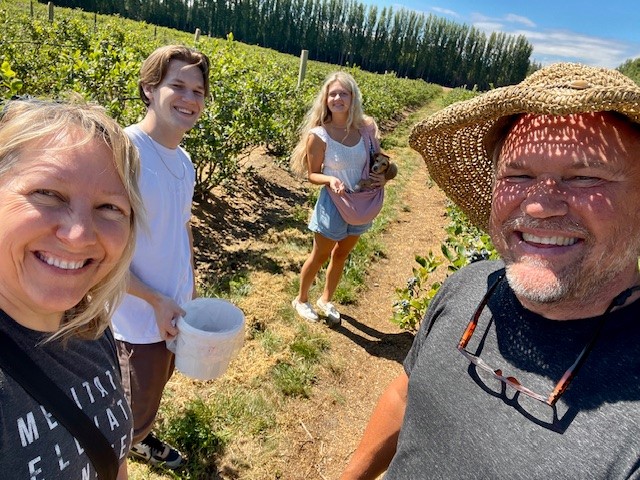
Steve and his wife Amber (left) go berry picking with their son Noah, his wife Hannah and their dog Poppy.
Steve Mitchell knew early on he wasn’t made for an office job — he’s an avid sportsman who loves staying active and being outdoors. Raised in Hermosa Beach, California, before moving to Federal Way, Washington, Steve graduated with a bachelor of science in oceanography from the University of Washington. He then moved to Sequim, a small town on Washington’s Olympic Peninsula, and managed a snowboard manufacturing facility. He later got into home building, working as a residential general contractor. When the 2008 housing crisis hit, he pivoted and secured a position with Weyerhaeuser. Since then, he’s managed multiple seed orchards and currently runs our seed orchard in Sequim.
“I didn’t fully know what I was getting into when I started, but it’s been fulfilling,” he says. “We enrich our communities, so the work has value. We make life better for ourselves and others, which is a pretty cool thing. It’s nice to feel stoked to get up and go to work every day.”
MEET STEVE
What do you do as a seed orchard manager?
I’m responsible for running our site here in Sequim, which is approximately 200 acres. l manage everything involved with getting a cone crop on our Douglas-fir and noble fir production blocks. It’s the first step in providing timber for sale. There aren’t many seed orchards in North America, and at Weyerhaeuser we have just three in the West: Sequim and Rochester in Washington, and Turner in Oregon.
Our main function is to harvest our crop every fall. Cones are shipped out and processed at our seed plant in Rochester. Rochester extracts the seed and stores it for later seedling growth at the greenhouses and nurseries. Then we use those seedlings to replant our timberlands in the West.
Steve and his family celebrate Thanksgiving together.
What makes Sequim a good location for a seed orchard?
Sequim is in what’s called a rain shadow. We’re one of the drier places in Western Washington. When storm systems come out of the south, the Olympic Mountains block a lot of that weather. Our average annual rainfall is only about 16 inches. And it stays pretty dry in the spring, which can be helpful for stimulating a crop on our trees during flowering.
Douglas-fir grows really well in Sequim. Sequim is a small “retirement” town, and career jobs can be difficult to find here, so working at the orchard is a cool job for anybody who’s committed to the area. We’re a team of two right now; my direct report, Luke Wonderly, grew up an hour and a half west, in Clallam Bay, so he also appreciates living out here.
Tell us what your day is like.
Generally, Luke and I show up around 7 a.m. We’ll knock out any computer work, pay bills, do office work and attend our meetings — about 20 percent of my time each week consists of meetings. Then, we make a plan for safe and efficient orchard work. There’s a lot to do in the orchard, so we often work independently in the field — except when supervised by Frannie, Luke’s dog.
What’s your favorite part of the job?
I enjoy the field work. I’m not really an office guy. When I was a general contractor, I enjoyed seeing the progress we made on a building at the end of a day. I get that here, too, whether I’m mowing or pruning trees. It’s nice to look back on your work and see how you made it better, to improve future processes and create efficiencies.
Working at a remote site at the tip of Washington state, Luke and I enjoy a fair bit of autonomy with the seed orchard, and I value that a lot. It’s rewarding to have stewardship over the orchard. In my view, our responsibility to Weyerhaeuser and the surrounding community is to ensure the orchard performs in a manner that supports Western Timberlands long into the future.
Steve, Frannie and Luke get ready for work in our Sequim seed orchard.
You must have some challenges. What are they?
It can be challenging to think far enough ahead into the future — 40 to 50 years. The work we do today doesn’t turn into a return on the investment for decades. For example, our young trees are planted close together, but at the right time we must thin those rows out to optimize harvest returns over the life of an orchard block. The weather windows are challenging, too. We have to look at what we need to get done this season and plan so we’re set up for next year’s cone stimulation and harvest regardless of what the weather throws at us.
Our irrigation systems are about 50 years old, so we have to make sure all those main lines and pumps are working. Those repairs can be quite expensive. It can be challenging to determine how much maintenance to do to keep our trees healthy and avoid any problems in the growing season.
Tell us something about your job that might surprise people.
Well, the joke with my family is, “What do you guys do up there? Just watch things grow?” [laughs] There’s a lot more to it than that. A lot of things have to happen at the right times to maintain a safe, productive site. There’s plenty of work to do.
One thing we do is a biennial stim treatment on the trees to encourage cone and pollen production instead of vegetative growth. There’s a fine line between keeping the trees in a reproductive state instead of a vegetative state. Our job is to make sure we have a cone crop with good seed yields in the years we harvest a production block.
What do you like to do for fun when you’re not at work?
I’ve been into water sports my whole life. I started surfing in my teens. My wife Amber and I windsurf just up the road from where we live. In the wintertime, we go up to Hurricane Ridge and either snowshoe or snowboard. I also enjoy music. I play guitar, and my son Elias has a drum kit, so we jam together. I am also into hunting and fishing, but I do it less often nowadays. There’s so much beautiful country up here, it would take a lifetime to do everything.