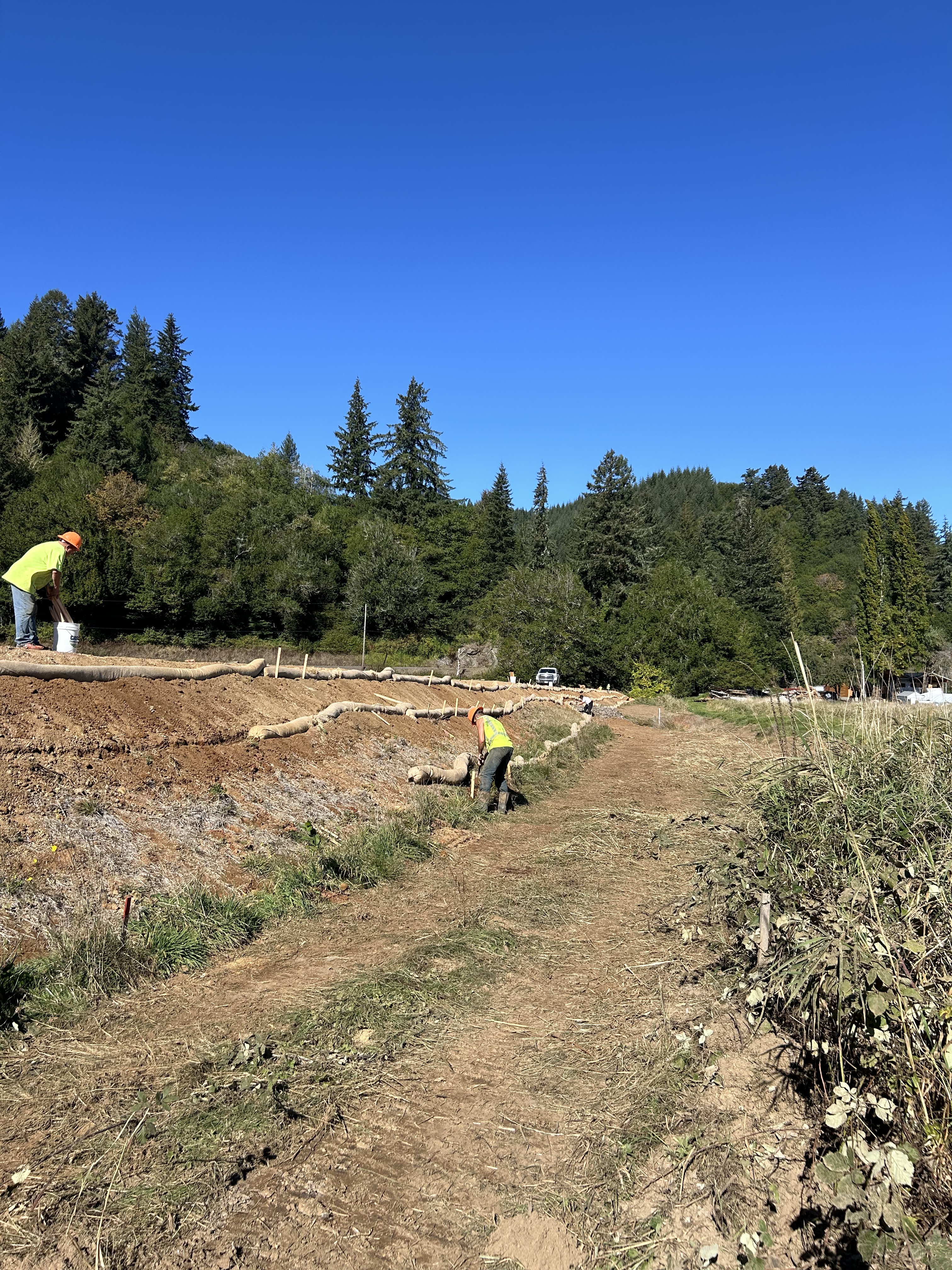
Crews work on the new, setback levee.
What began as a failing tide gate has become one of our most ambitious watershed restoration projects in Oregon. The project reconnects nearly 11 acres of historical floodplain at the confluence of two major river systems and creates critical habitat for young salmon.
Located just east of Coos Bay, where the Millicoma and South Fork Coos rivers meet, the site sat largely unused for decades. Once part of a log-rafting operation supporting our Coos Bay sawmill, the small triangular parcel remained in Weyerhaeuser ownership as pastureland long after the mill closed.
Then, in 2016, tidal waters began overtopping the levee.
“When the tide gate started failing, our initial goal was simple — protect nearby homes and fix the infrastructure,” says Jason Richardson, Coos Bay area manager. “But once we started looking at the site more closely, it became clear there was a much bigger opportunity.”
A PROBLEM BECOMES A RESTORATION PROJECT
Jason reached out to the Coos Watershed Association, Oregon Department of Fish & Wildlife and other partners to rethink the entire landscape. A plan began to take shape: move the levee back, restore tidal influence and allow the land to return to a floodplain.
“This is prime habitat for juvenile salmon,” Jason says. “It’s where freshwater meets saltwater, where young fish need places to rest, feed and adjust before heading out to the ocean.”
The project design connects tidal wetlands, creates meandering channels, installs large woody debris for shelter and establishes hummocks for native vegetation. At the same time, a new setback levee and tide-gated culvert also provide continued flood protection for neighboring homes.
Ky Smith, forest engineering specialist, was on site during construction work.
FUNDING THE FINISH LINE
A key milestone came when the project received funding through Oregon’s Private Forest Accord, a program that supports ecological improvements on private forestlands.
“The PFA funding was absolutely pivotal,” says Haley Lutz, executive director of the Coos Watershed Association. “It’s what ultimately got this project off the ground.”
Other large funding grants came from the Oregon Watershed Enhancement Board, NOAA’s Wild Salmon Center, the Oregon Department of Forestry and Wildlife, and Weyerhaeuser.
“This was never just about fixing infrastructure,” Jason says. “The PFA funding allowed us to raise the bar and fully restore the site instead of simply mitigating.”
The funding also supported local contractors and suppliers, keeping much of the investment in the community.
STAYING THE COURSE
Though construction was expected to take multiple years, it ended up stretching into nearly a decade. Ky Smith, forest engineering specialist, was our on-the-ground representative during construction.
“There were plenty of points where this could have stalled out completely,” Haley says. “Weyerhaeuser could have gotten frustrated and walked away, but instead they stayed engaged and focused on the original goals.”
Construction officially wrapped up earlier this year, and our teams are now working through the final steps to donate the property for long-term conservation.
“Weyerhaeuser deciding to fully open this property for ecological value — essentially putting it into conservation in perpetuity — is really above and beyond what many working landowners would do,” Haley says.
Over time, natural tidal cycles will reshape the channels, while newly planted native species help rebuild the food web from the ground up.
“We designed this site to let nature do what it does best to protect Coho salmon, a threatened species,” Haley says. “Water finds its way. Our role was to set the landscape back on the right path.”
For Jason, seeing the transformation has been deeply rewarding.
“I drive by this site with my kids all the time,” he says. “To know it’s going back to what it was meant to be — that’s pretty special."
Haley hopes the project serves as an example of what’s possible when forestry professionals and conservation partners work together.
“There’s this old narrative that forestry and environmental groups don’t mix,” she says. “But this project shows that real, trusting relationships can exist, and that they can lead to meaningful restoration.”
As tidal waters return and young salmon begin using the site, the Coos Bay restoration stands as a lasting reminder that protecting communities, supporting working forests and restoring ecosystems don’t have to be competing goals.
Sometimes, they flow together.