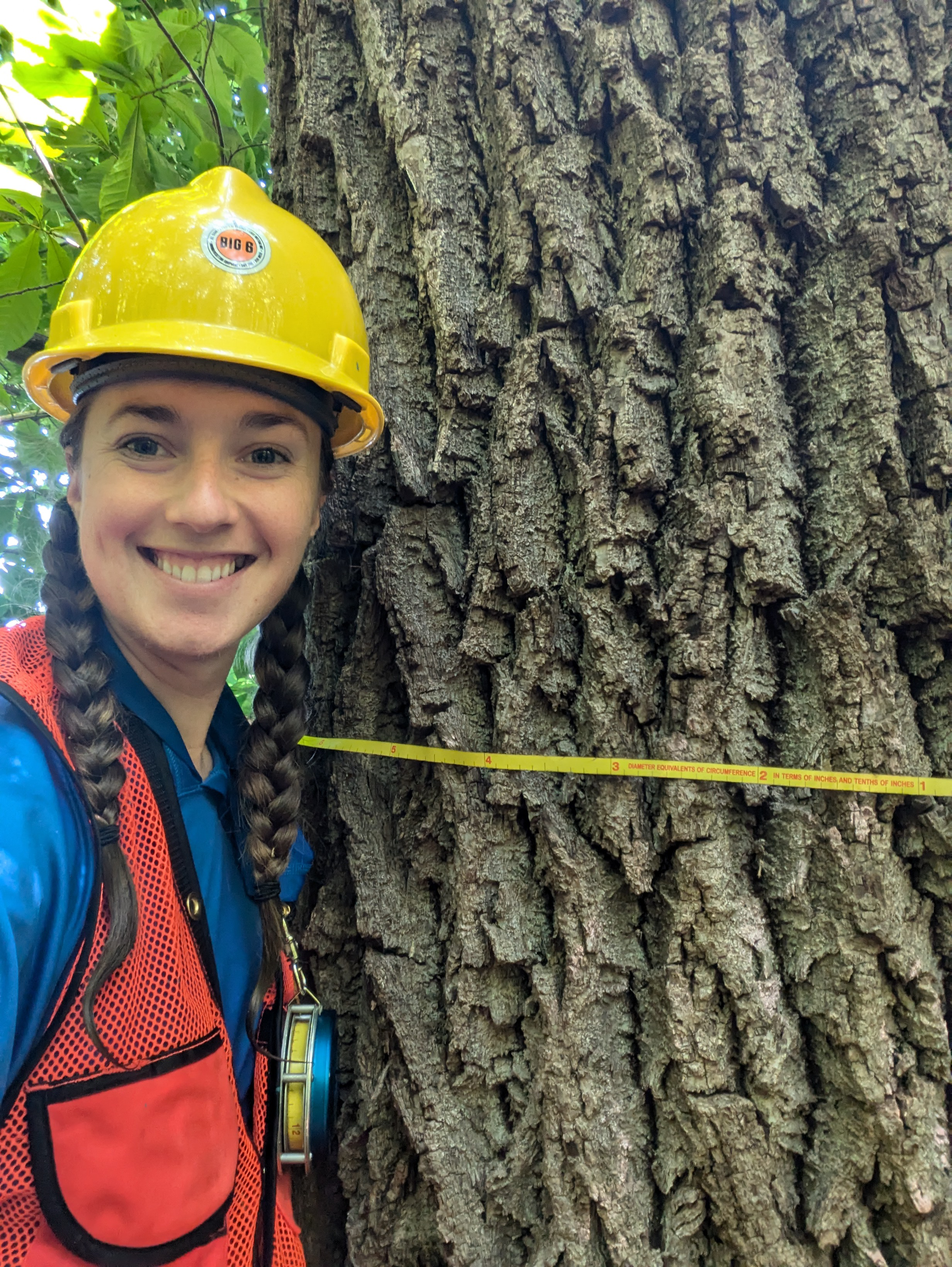
Andie measures a black walnut tree on the James River in Virginia.
As an environmental science and conservation biology major at Duke University, Andrea “Andie” Kolarova did not expect to go into industrial forestry.
“I was not educated about forestry in my degree program, only deforestation,” she says. “If you’d asked me after I finished undergrad, I would have said that cutting down trees was always a bad thing.”
Then a forest health assignment with AmeriCorps started Andie on her path to Weyerhaeuser. When her AmeriCorps work was done, she returned to Duke for a dual master’s in environmental management and forestry and interned on our Vail tree farm in Washington state.
“I learned that companies like ours have a role to play in conservation,” she says. “I became interested in intensive or High Yield Forestry because of our role in keeping our forests green while meeting consumer demand with renewable resources.”
Shortly after completing her master’s degree, she accepted an internship at the Forest History Society in Durham, North Carolina, which houses all our company records.
“I love talking about forest history, so I started working on a collection of Weyerhaeuser advertising from the twentieth century,” she says. “I had no idea I would one day be a Weyerhaeuser employee! I actually interviewed for my professional development position with the Virginia team while at my desk at the FHS.”
She left her internship for the professional development role, where she stayed for a year before landing a forester position in Oregon.
Andie and members of the Lynchburg Timberlands team volunteer at Lynchburg Daily Bread, serving free warm meals to community members.
GET TO KNOW ANDIE
Why did you choose Weyerhaeuser?
Weyerhaeuser is unmatched in terms of skill development and opportunities for advancement. Eventually, I want to step into a harvest manager or forest engineer role, and there’s not very many places I could do that.
How do you describe what you do to your family and friends?
Since I’m a forester, I just tell them I help plant trees! But if someone has a deeper interest, I talk about fire preparedness, fertilization, pre-commercial thinning, and applying herbicides for site prep and release treatments, too. We don’t just stick trees in the ground and walk away!
I also like explaining what industrial forestry and High Yield Forestry are about. I think a lot of people have misconceptions about what we do.
How do you explain WY to your family and friends?
I talk about how much land we’re responsible for, how many different species of trees we grow, and how we have different management styles depending on where we are in the country. We’re stewards of the land and a powerful partner for conservation projects.
What’s been your favorite project so far?
I got to see the Baber Mill Dam removal project while I was in Virginia. Our team had partners from the state, the Fish and Wildlife Service and the Department of Natural Resources. I’d learned about dam removal as an undergrad, but I'd never seen a project like that before. It showed me that we do commit real money, time and labor to conservation. I hope to be part of similar projects in the future.
Andie demonstrates the proper way to plant a tree at a free event for the public at our Aurora nursery in Oregon.
What do you want to learn more about?
I'm really interested in operations. I want to get experience as a forest engineer and/or harvest manager because I think it will help me understand the entire cycle of sustainable forestry. I'm also interested in research.
What've you liked so far about the company?
Great mentorship and caring leaders. I’ve been very lucky to have such positive experiences with the people who are guiding me: Maria Erdmann, my mentor when I was an intern, and Charles Smith, who was my mentor when I was in my professional development role. Now I have a fantastic area manager. No matter where I've been, I’ve felt free to seek help.
Tell us a bit about your team.
Our Mid Coast tree farm team is so fun and friendly. We come together every week for team meetings, and our inclusion events have high participation rates. People have been great across the region, too, inviting me to get cross-business experience, from our wildlife biologist to harvest managers.
I’m especially grateful for two of my coworkers, Travis Emerling and Don Irons. They were instrumental in helping me get started in my role.
Andie shows off her clamming haul during her summer internship at our Vail tree farm in Washington.
What's been most different from where you came from?
Washington and Oregon have some of the strictest forestry rules in the country. It requires more advanced planning and preparedness. The land history is also different. The trees grow for so much longer — I'm more accustomed to smaller trees that grow faster, for pulp and paper products. We make a different product class here, with a major export business and higher value product classes.
Have you had any bumps in adapting along the way?
I struggle with feeling comfortable when I don't have all the answers. I don't want to make mistakes, but I do simply because I am new and I don't know everything. But I have good and caring leaders who support me as I grow.
Where do you see yourself in 5 years?
My goal is to be as good a forester as I can be in my current role. Eventually, I would like to have experience in other operational roles within Timberlands. Long term, I hope to circle back to environmental science research and conservation. I have an interest in R&D or environmental management systems, especially.