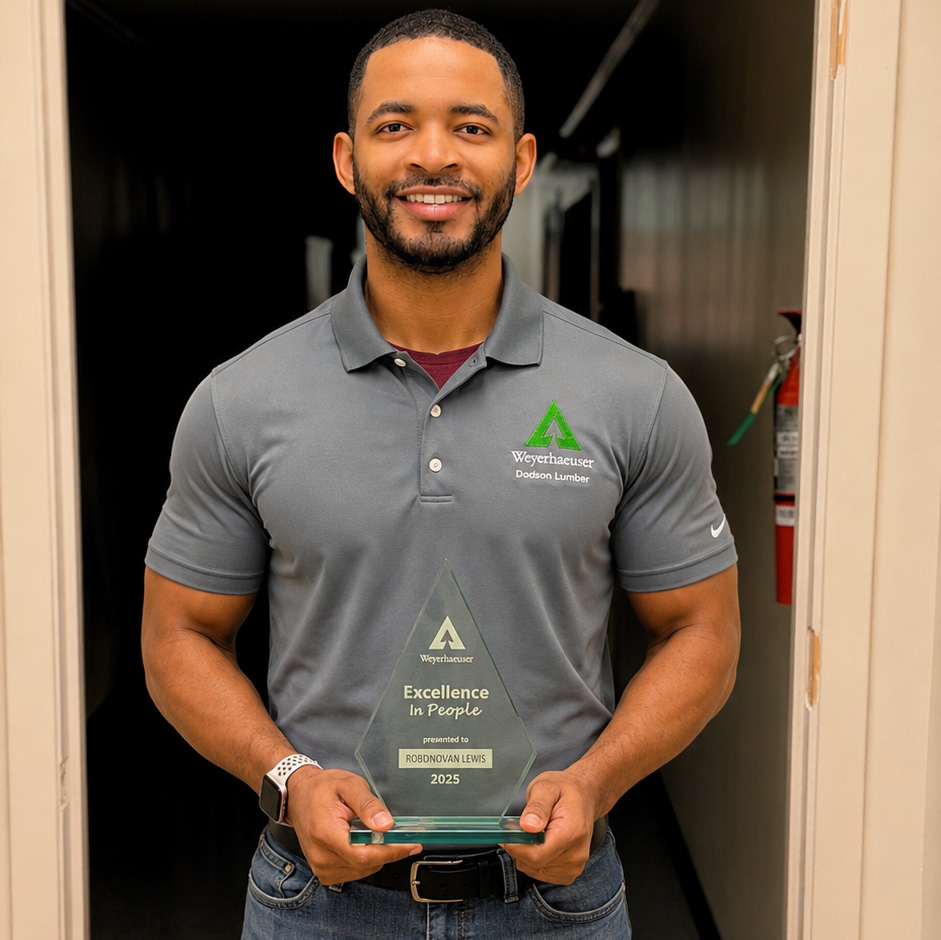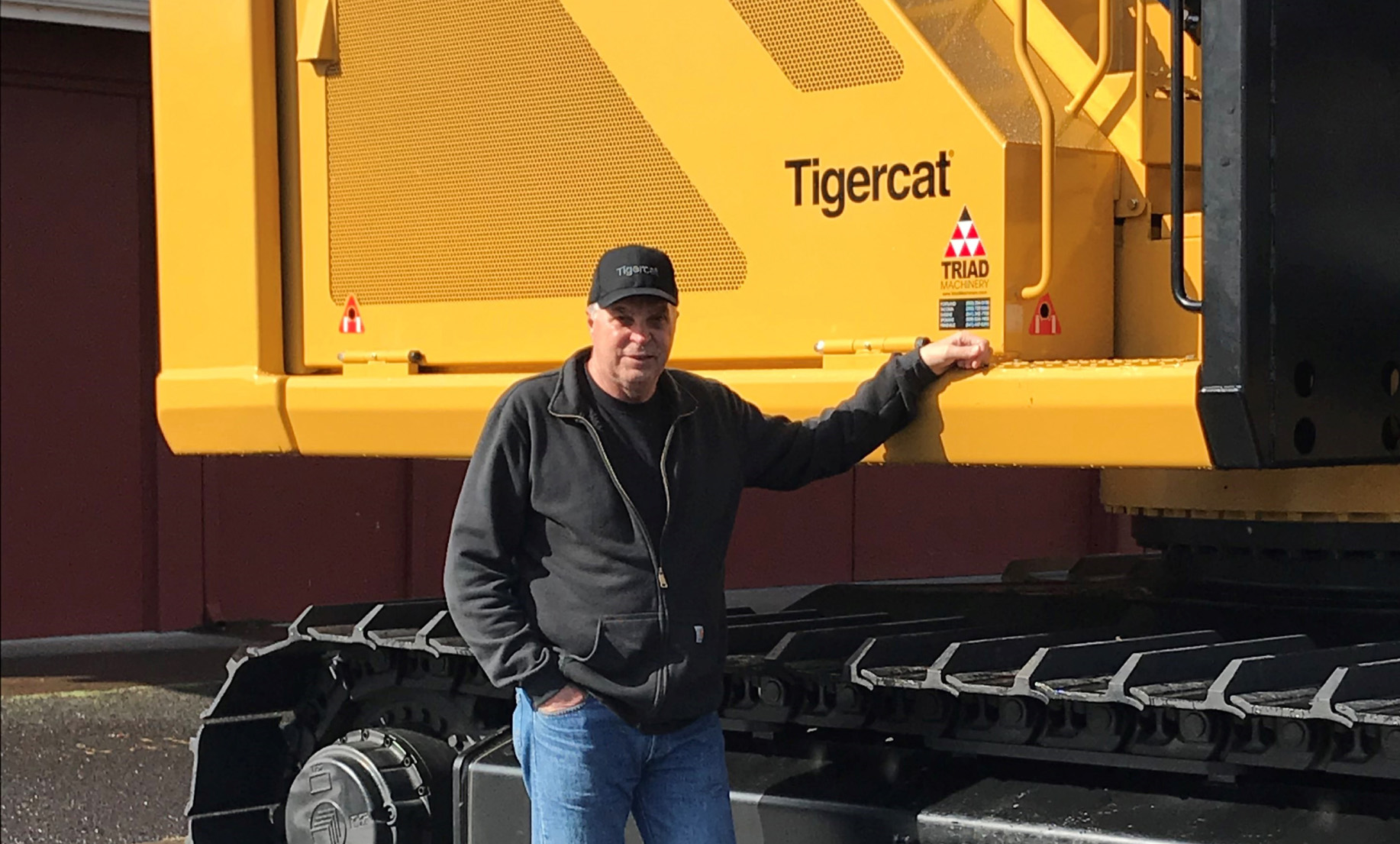
Nathan, his wife Destiny and their daughters Harper (3) and Charlotte (1).
Dumping hoppers are a fixture at our Panels facilities — they’re affixed to forklifts and used daily to move ash, sawdust and other materials around the site. But each time an operator dumped the hopper’s load, they had to climb out of the forklift and manually work the latch — exposing them to multiple potential hazards that could result in slips, trips and falls, or even finger amputation.
Nathan Clevenger, an operations team member at our Sutton OSB plant in Heaters, West Virginia, thought there had to be a better way. His supervisor agreed and suggested a challenge: figure out if there’s any way to do this without the operator ever leaving the cab. Nathan succeeded — and in doing so, he was recognized as one of five winners of our 2025 Innovator of the Year awards. Launched in 2021, this annual award recognizes and celebrates employees who are driving improvements and fueling operational excellence through their ideas, actions, and the innovative environment they help create on their teams.
“Nathan’s low-cost innovation makes a big difference once all the hoppers at a given site are modified,” says Jason Minchin, vice president of Engineering, Reliability & Innovation. “It’s a smart way to solve the problem, and it’s easy to replicate.”
FROM WHITEBOARD TO WORKING PROTOTYPE
The solution took shape on a night shift, with Nathan and shift maintenance technician Michael Parks sketching ideas on a whiteboard. The key was finding a mechanism that would automate the dump without removing the ability to operate the hopper manually — a requirement that made the design more complex.
“Part of the issue was it still needed to work and function as it did before,” Nathan says. “I had to come up with a bracket design that allows you to still manually dump it with the handle.”
After cycling through multiple concepts, bouncing ideas back and forth with Michael, Nathan landed on a small linear actuator paired with a breakover latch system. He tested it first with a cardboard prototype. Once the geometry looked right, he fabricated a temporary version from cut metal parts, pinned it together on an actual hopper, and switched it on.
It worked. Within about two months of first receiving the challenge, the prototype was welded solid and in active use.
“You pull up, press a button in the cab and dump the hopper,” Nathan says. “Then it rolls back and latches, and you can go back to what you were doing — without ever leaving the forklift seat.”
The final design adds a control button and retractable power cord to the forklift, keeping operators safely inside the cab at all times. A refinement since the original build has also reduced the required actuator stroke from an estimated 10 inches down to just four, making the system compatible with a much wider range of hopper sizes.
The controls were also simplified: where the original design required separate button presses to unlatch and relatch, the updated version unlatches when you press the button and automatically returns to the latched position when you let go.
Nathan and a young Harper with their catch of the day.
A SIMPLE FIX WITH BIG POTENTIAL
The safety impact is the headline, with the possibility of engineering risk out of the system and completely eliminating hopper-related injuries by keeping operators inside the forklift cab.
The economics back it up, too. Each hopper modification costs around $500, compared to $6,500 to replace a hopper with a newer-style unit that would offer similar safety benefits. That saves about $6,000 per hopper. With 60 hoppers on site, full implementation represents up to $360,000 in cost avoidance.
And the idea is already spreading. Nathan has shared blueprints with multiple other mills and distribution centers exploring adoption, and he is actively helping our Arcadia OSB plant in Simsboro, Louisiana, implement the modification. He was also recognized with a Most Impactful Innovation Award from Wood Products for his work on the innovation.
PROBLEMS ARE JUST A CHANCE TO GET CREATIVE
Nathan’s approach to innovation is straightforward: start with the end goal and work backwards.
“I figure out what I need it to do and why, and then reverse engineer the solution, taking the end idea and figuring out what to do to transform it,” Nathan says. “If I hit a wall, I walk away from it for a little while, focus on something else, and then come back with fresh eyes. I enjoy the chance to do some creative problem-solving, especially when it makes work safer and easier for everyone.”